A recent study conducted by the Common Market for Eastern and Southern Africa (Comesa) and the University of Johannesburg's Centre for Competition, Regulation and Economic Development has found that domestic sugar prices in Malawi are significantly higher than export prices. The study attributes this disparity to market conditions and government policies governing the sugar industry. Limited competition has contributed to domestic sugar prices being around 85% higher than export prices.
The study, which also drew input from the Competition and Fair Trading Commission, noted that foreign currency shortages and the depreciation of the kwacha have constrained access to imported sugar and production inputs. Most authorised sugar imports originate from Comesa and Southern African Development Community (Sadc) markets, where traders benefit from duty waivers, influencing pricing dynamics in the domestic market. This has resulted in a significant gap between domestic and export prices.
The analysis revealed that millers generate higher prices for sales of sugar in the domestic market compared to export markets due to protection from competition. Industrial customers reported that in periods where they are allowed to import sugar, the landed cost of the sugar is cheaper than domestic prices. The Control of Goods Act requires government permits for sugar imports, limiting access to competing regional supplies. This legislation has contributed to the high domestic sugar prices.
The Sugarcane Industry Act regulates and controls the growing and sale of sugarcane and sugar production in Malawi. The country has two sugar manufacturing companies: Illovo Sugar (Malawi) plc, listed on the Malawi Stock Exchange, and State-owned Salima Sugar Company. Illovo Sugar (Malawi) plc produced between 221,190 metric tonnes (MT) and 279,278MT from 2019 to 2024, while Salima Sugar Company's output rose from 5,000MT to 21,000MT during the same period.
Illovo Sugar (Malawi) plc managing director Ronald Ngwira responded to the findings, stating that the challenge lies in the exchange rate used to reach these conclusions. He argued that the company cannot source its inputs at the official rate, making the cost of production in Malawi high. Ngwira claimed that Malawian sugar remains competitive at the parallel rate compared to neighbouring countries.
Consumers Association of Malawi executive director John Kapito noted that while Malawi's high sugar prices reflect its dominant local position, export commitments, and high production costs, opening the market could lower prices but risk jobs, sugar supply, and forex earnings. Kapito suggested that Malawi must address the high cost of production, including electricity, interest rates, and transport, to make local sugar more affordable.
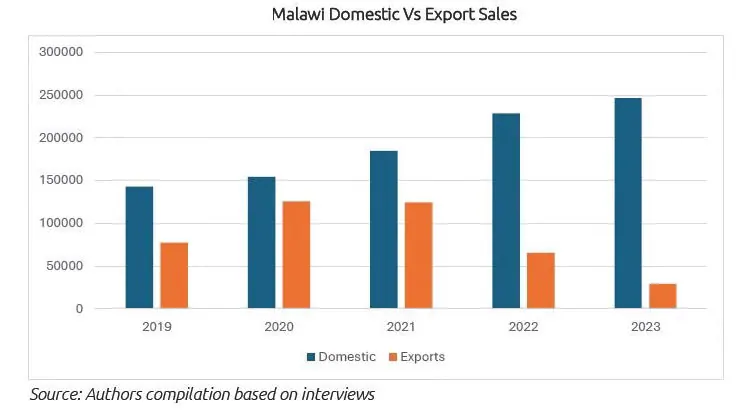
The findings come as domestic sugar consumption and exports have fluctuated in recent years. Domestic sugar consumption rose from 142,716MT in 2019 to 246,432MT in 2023, before declining to 227,017MT in 2024. During the same period, sugar exports fell sharply from 125,546MT in 2020 to 29,449MT in 2023 as domestic demand increased, production was affected by climate-related shocks, and export controls were introduced in 2022.
Key points
- Domestic sugar prices in Malawi are 85% higher than export prices due to limited competition and government policies.
- The study suggests that opening the market to imports could lower sugar prices but risks jobs, sugar supply, and forex earnings.
- Malawi's sugar industry faces challenges, including high production costs, limited competition, and a regulatory framework that restricts access to alternative supplies.