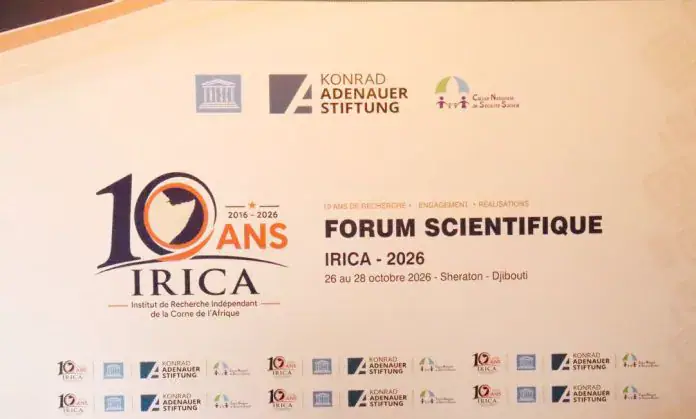
The Institut de recherche pour le développement de la Corne de l’Afrique (IRICA) recently celebrated its 10th anniversary with a scientific forum that brought together researchers to discuss the role of research in addressing major development challenges. The forum featured 32 communications on various topics, including environment, energy, education, health, governance, and economy. These discussions highlighted the importance of research in informing public policies and exploring solutions to national and regional challenges.
Environmental issues were a significant focus of the forum, with researchers presenting studies on climate change, energy, and waste management. Dr. Idriss Bexi Warssama, a climate change expert, analyzed 94 studies published between 2003 and 2023 on methods for evaluating climate vulnerability. He emphasized the need for better integration of health consequences, strengthening early warning systems, and investing in local knowledge. Other researchers examined waste management practices, including the participation of civil society organizations and the handling of medical waste in healthcare facilities.
The forum also explored the transition to renewable energy and its impact on human development. A comparative study on Djibouti, Ethiopia, Kenya, and Eritrea between 1990 and 2020 found that renewable energy has positive long-term effects on human development. Researchers stressed the importance of investing in green infrastructure and adapting governance to support this transition. Additionally, studies examined the potential for introducing waste sorting in Djibouti, drawing on Japanese experiences, and the need for adapted infrastructure and public awareness.
The forum's second panel focused on human development, governance, and new economic perspectives. Researchers discussed education, health, and human capital, including inequalities in school performance, language transmission, and the use of artificial intelligence in learning. Several studies highlighted the importance of teacher training, adapting pedagogical methods, and preserving linguistic heritage. In the health sector, researchers addressed various issues, including asthma in children, male infertility, and hearing health in older adults.
Governance was another key theme, with nine communications on the rule of law, cybersecurity, human rights protection, local elections, decentralization, and citizen participation. Researchers emphasized the role of transparency, public service quality, and institutional trust in social cohesion. Traditional community regulation mechanisms were also studied as components of social organization. Furthermore, the forum explored Djibouti's tourism potential, electricity interconnection with Ethiopia, and the history of colonial monetary regimes.
The forum's final panel examined the economy and geostrategy, including the potential for tourism development, electricity interconnection with Ethiopia, and the impact of artificial intelligence. Researchers highlighted opportunities related to Djibouti's strategic position, while also emphasizing the challenges of energy dependence, economic diversification, and digital sovereignty. The forum demonstrated the diversity of research fields and offered insights into national realities, development choices, and solutions adapted to population needs.
The IRICA forum illustrated the importance of research in addressing development challenges in Djibouti. The studies presented provide a foundation for understanding national realities, informing development choices, and identifying adapted solutions. The next step is to valorize these findings and promote their use in public policies and development initiatives. By doing so, Djibouti can leverage research to drive sustainable development and improve the lives of its citizens.
Key points
- The IRICA forum highlighted the need for research-based solutions to address development challenges in Djibouti.
- Environmental issues, including climate change and waste management, were a significant focus of the forum.
- The forum emphasized the importance of investing in green infrastructure and adapting governance to support the transition to renewable energy.