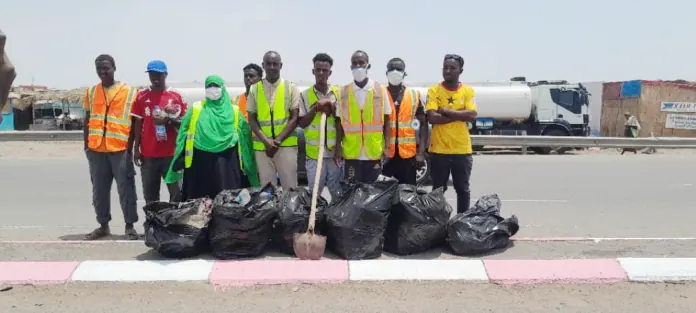
The city of Ali Sabieh in Djibouti has implemented a new approach to waste management, combining proximity services, citizen participation, and local collective involvement. The Ali Sabieh Road Agency (AVAS), created in 2019, aims to collect household waste and improve living conditions in the regional capital. This initiative has evolved to go beyond mere waste collection and promote sustainable waste management. The AVAS has established an organization involving regional authorities, neighborhood committees, and residents.
The waste management system in Ali Sabieh has been strengthened since August 2024, through discussions between regional authorities, neighborhood committees, and local actors. These meetings, led by Prefect Abdoul-Malik Mohamed Banoïta and Regional Council President Charmake Hassan Allaleh, have facilitated the identification of challenges, assessment of waste collection, and development of tailored solutions. This approach focuses on proximity, with the AVAS maintaining regular exchanges with neighborhood committee leaders to monitor needs, address issues, and raise awareness among residents.
The waste collection process in Ali Sabieh utilizes tricycles, known as "Bajaj," which operate from Sunday to Thursday. The goal is to facilitate regular waste evacuation and minimize accumulation in public spaces. This setup aims to make services more accessible to residents by decentralizing collection points and establishing a consistent waste removal schedule. Additionally, residents contribute 500 Djibouti francs per month to support service expenses, including fuel, tricycle maintenance, and collector remuneration.
The AVAS has observed a significant reduction in illegal dumping and improved cleanliness in several neighborhoods since implementing this system. However, according to AVAS Director Ali Farah Djama, the next step is to focus on behavioral change and enhance citizen responsibility. He emphasizes that residents must feel invested in maintaining their city's cleanliness and understand their role in preserving it. This involves shifting from mere waste collection to addressing waste production, disposal, and valorization.
The AVAS is exploring a more comprehensive waste management approach, incorporating prevention, sorting, recycling, and valorization. To achieve this, the agency requires better knowledge of local waste generation and quantities, as well as necessary skills and equipment. The AVAS has received support from various partners, including the International Organization for Migration (IOM), the Regional Council, the Prefecture, the French Embassy, the Djiboutian Social Development Agency (ADDS), and the United Nations Development Programme (UNDP).
These partnerships have enabled the AVAS to benefit from external expertise, such as the Appui au développement et aux initiatives locales (ADIL) program, funded by the European Union and implemented by Expertise France. This support has helped strengthen the agency's capacities and improve services to users. A diagnosis of the existing system and a development strategy were conducted in early 2023, and a collaboration with Cyclad, a French public intercommunal service, has brought new insights to the waste management process.
The experience of Cyclad, a service public intercommunal specialized in waste management in Charente-Maritime, has been shared with AVAS teams through a study visit and expert exchanges. This exchange has allowed for the sharing of best practices and expertise, contributing to the development of an adapted waste management model in Ali Sabieh. The goal is to create a system that takes into account local habits, neighborhood characteristics, available resources, and treatment possibilities.
Key points
- The Ali Sabieh waste management system combines proximity services, citizen participation, and local collective involvement.
- The system has led to a significant reduction in illegal dumping and improved cleanliness in several neighborhoods.
- The AVAS aims to evolve its approach to focus on prevention, sorting, recycling, and valorization of waste.