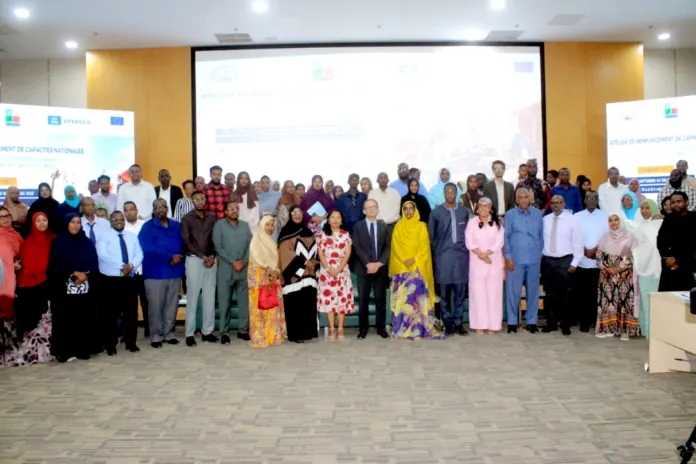
The National Library and Archives of Djibouti has become a hub for discussions on the future of cultural and creative industries. The five-day workshop, which started on September 28, 2026, brings together artists, entrepreneurs, sector professionals, institutional representatives, and international partners. The event aims to explore ways to enhance skills, facilitate access to financing and markets, and create a more favorable environment for cultural initiatives to thrive.
The workshop's opening ceremony was attended by notable figures, including Minister of Youth and Culture Fardoussa Moussa Egueh, Director-General of the National Agency for the Promotion of Culture (ANPC) Mohamed Houssein Doualeh, UNESCO representative Idil Moussa, and European Union's first counselor in Djibouti Patrick Dupont. The participants will engage in discussions on the conditions necessary for developing a more favorable ecosystem for cultural entrepreneurship. Key issues to be addressed include access to financing and markets, skills development, and the role of digital technology.
The project is a joint initiative of the European Union, UNESCO, and the Ministry of Youth and Culture. According to Patrick Dupont, the project reflects a shared vision of making culture a driving force for development. He highlighted the significance of cultural and creative industries, which account for 3.1% of the global GDP and employ over 30 million people worldwide. In Djibouti, the sector has considerable potential, but it requires tailored support and structuring.
The workshop is built on previous work, including consultations with cultural actors, peer-to-peer learning missions to Morocco and Tunisia, and initial work on a strategy for developing cultural entrepreneurship in Djibouti. Saji Thiam, UNESCO's project manager for the 2005 Convention, emphasized that the workshop aims to consolidate these achievements, strengthen actors' skills, and advance the strategy collectively.
Minister Fardoussa Moussa Egueh stressed that the workshop is a crucial step in Djibouti's efforts to develop cultural and creative industries. She noted that the country has been committed to these industries since ratifying the 2005 UNESCO Convention in 2007. The minister called on participants to share their experiences and propose solutions to enable more Djiboutians to make a living from their creativity and establish sustainable cultural enterprises.
The workshop will enable participants to review the results of studies conducted within the project framework, discuss peer-to-peer learning missions, and explore prospects for sector development. The discussions will focus on creating an environment conducive to cultural entrepreneurship, including institutional and regulatory frameworks, and the opportunities offered by digital technology.
The project's objective is to contribute to the creation of a favorable environment for entrepreneurship in cultural and creative industries through national capacity building and the development of a data-driven national strategy. This strategy aims to identify needs, opportunities, and obstacles faced by professionals in the sector, ultimately enabling Djibouti to harness the potential of its cultural and creative industries.
Key points
- The workshop aims to strengthen national capacities for promoting entrepreneurship in cultural and creative industries.
- The project is a joint initiative of the European Union, UNESCO, and the Ministry of Youth and Culture.
- The cultural and creative industries have considerable potential in Djibouti, but require tailored support and structuring.