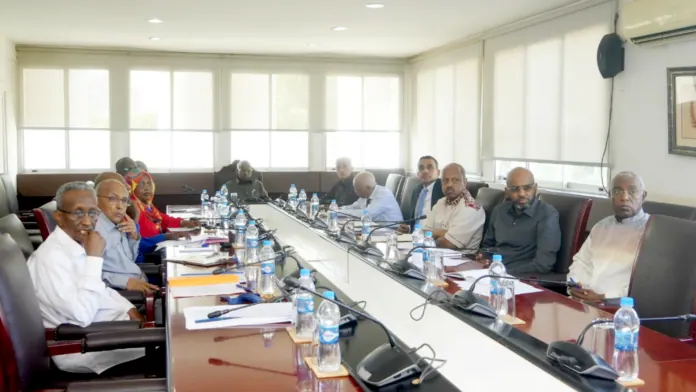
The government of Djibouti is shifting its focus towards a more targeted approach to economic growth, with a emphasis on a limited number of high-impact projects. This new strategy was presented by Prime Minister Abdoulkader Kamil Mohamed, who chaired a meeting on the implementation of the second axis of the country's economic plan, "Growth and Economic Diversification". The meeting brought together several ministries, the Planning Commission, the General Secretariat of the Prime Minister's Office, and relevant technical committees.
The main areas of discussion included industrialization, diversification of economic activities, modernization of infrastructure, and improved governance of investments. The government aims to translate its economic diversification policy into concrete actions, focusing on projects that can have a measurable impact on economic activity and employment. The creation of jobs is at the heart of this new strategy, with a focus on sectors that can generate more value from local resources and capacities.
The agro-food, fisheries, and pastoral sectors have been identified as key areas for development, with the goal of transforming local resources into productive activities beyond traditional sectors and increasing employment opportunities. The government also highlighted the importance of improving access to quality energy and water, as well as developing digital infrastructure and internet services, as essential conditions for the emergence of a more competitive economy.
To avoid dispersing resources, the Prime Minister has requested that the roadmap be focused on six to twelve structuring projects, selected based on their expected impact, level of maturity, and availability of financing. This approach aims to prioritize projects that are sufficiently advanced and funded to quickly enter an operational phase, and to better articulate economic priorities with real implementation capacities and available resources.
Several institutional projects will also need to be accelerated, including the revision of the Investment Code, the modernization of multimodal logistics, and support for digital industrialization. The roadmap will also need to specify, for each selected project, the responsibilities of the different actors, deadlines, and expected results. This will enable a more precise monitoring system, moving from general orientations to a more detailed device.
The government aims to have a revised roadmap that is focused on identified, funded, and directly operational projects. This new approach aims to strengthen economic diversification, improve competitiveness, and make job creation a central indicator of the action taken within the framework of Axis II. The revised roadmap is expected to provide a clearer direction for the country's economic development.
The implementation of this new strategy will be closely monitored, with a focus on achieving concrete results. The government has emphasized the importance of improving the business environment and increasing investment in key sectors. By prioritizing a limited number of high-impact projects, the government hopes to achieve significant economic growth and job creation in the coming years.
Key points
- The Djibouti government is prioritizing a limited number of high-impact projects to accelerate economic transformation and job creation.