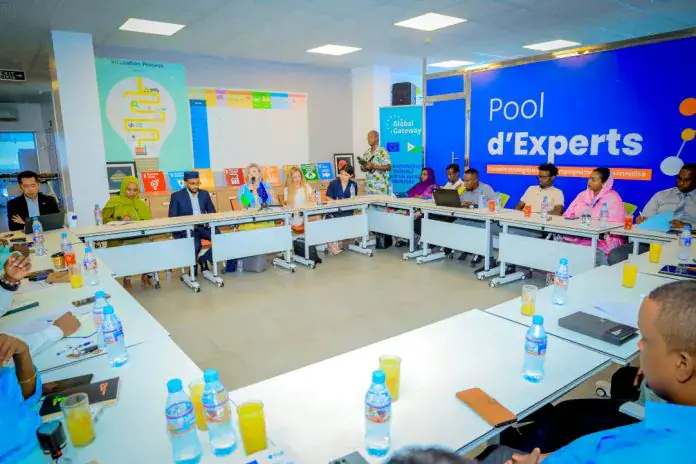
On October 25, 2026, the Center for Leadership and Entrepreneurship (CLE) in Djibouti hosted a meeting between public institutions, private sector representatives, and support structures to discuss the challenges faced by micro, small, and medium-sized enterprises (MSMEs). The event, organized by the European Union in partnership with the CLE, aimed to promote professional insertion of young people, facilitate business development, and strengthen job creation prospects.
The meeting brought together representatives from the Guarantee Loan Fund, the Economic Development Fund, the Djiboutian Office of Industrial and Commercial Property (ODPIC), private partners, support structures, and Djiboutian entrepreneurs. Discussions focused on four key issues for MSMEs: access to financing, formalization of activities, skills development, and simplification of administrative procedures. These challenges are crucial for entrepreneurs to develop their activities, improve competitiveness, and create sustainable jobs.
In his opening speech, the CLE's Director-General emphasized the central role of youth in the country's economic dynamic, highlighting entrepreneurship as a concrete response to professional insertion challenges. He noted that youth are not only the future but also a present force, full of energy, ideas, and ambitions. The European Union is supporting this dynamic through the MSMEs project, which aims to promote the growth and competitiveness of Djiboutian MSMEs with a budget of €3.9 million.
The MSMEs project, implemented by the World Bank in partnership with the Ministry of Digital and Innovation, has already supported over 585 businesses and contributed to the establishment of a one-stop shop to facilitate access to services and simplify entrepreneurial procedures. Other initiatives, such as the DRIVE project, which supports entrepreneurs in the livestock sector, and the E-SKILLS program, which develops digital skills, are also contributing to this dynamic.
The European Union's Ambassador to Djibouti stressed the importance of listening to young people and entrepreneurs to better understand their needs and design adapted responses. She also highlighted the need to strengthen links between public institutions, the private sector, and support structures to facilitate access to existing resources and create a more favorable business environment.
The meeting demonstrated the need for reinforced coordination between the different actors in the entrepreneurial ecosystem. Access to financing, training, simplification of procedures, and support for project leaders are complementary levers to promote the emergence and sustainability of businesses. By bringing decision-makers closer to the realities experienced by entrepreneurs, the European Union and the CLE aim to contribute to a more inclusive economic dynamic.
The partnership between the European Union and the CLE reflects a shared commitment to supporting Djibouti's economic development and promoting employment and entrepreneurship. The two organizations will continue to work together to address the challenges faced by MSMEs and promote a more favorable business environment, ultimately contributing to the country's economic growth and sustainable development.
Key points
- The European Union has allocated €3.9 million to support the growth and competitiveness of Djiboutian MSMEs through the MSMEs project.