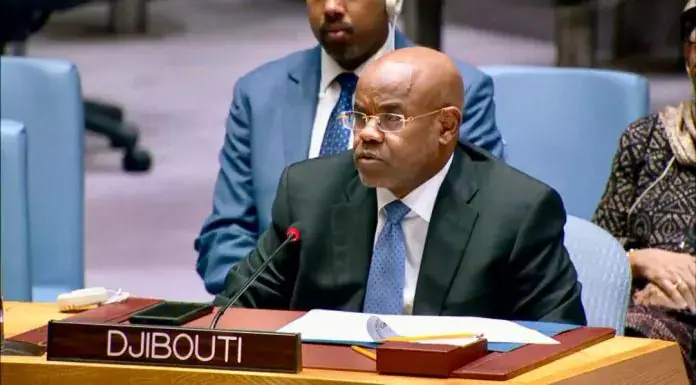
Djibouti's Ambassador to the United Nations, Mohamed-Siad Doualeh Warsama, addressed the UN Security Council, emphasizing the need for a binding international framework to govern the military use of artificial intelligence and autonomous weapons. He warned that these emerging technologies pose significant threats to maritime security, civilian infrastructure, and developing countries. The rapid evolution of technology is transforming the nature of conflicts, making them more unpredictable and difficult to contain.
The debate, initiated by Latvia, focused on the challenges posed by new technologies in conflict resolution. Ambassador Warsama highlighted the risks associated with drones, artificial intelligence, and cyber-attacks, which can be used by both major powers and non-state actors. He stressed that these technologies make war more accessible, unpredictable, and difficult to contain, posing significant risks to small states and developing countries with limited defense capabilities.
Djibouti's concerns are particularly relevant given its strategic location near the Bab el-Mandeb Strait, a critical waterway for international trade. The country's ambassador emphasized that maritime insecurity threatens its ports, investments, food security, employment, and economic prospects. He also drew attention to the vulnerability of critical infrastructure, such as undersea communication cables, energy installations, and logistics networks.
To address these challenges, Djibouti proposed five strategic priorities. First, it emphasized the importance of preserving human control over the use of force, arguing that decisions to take human life cannot be delegated to algorithms. The country also supports the adoption of a binding international instrument establishing prohibitions and restrictions on autonomous weapons, as called for by the UN Secretary-General and the President of the International Committee of the Red Cross.
Djibouti's second priority focuses on protecting international maritime routes and essential civilian infrastructure. The country believes that the UN Security Council must enhance cooperation to safeguard commercial vessels, seafarers, ports, and undersea cables from emerging technological threats. This effort should respect the sovereignty of coastal states and their role in regional maritime security.
The third priority involves preventing the proliferation of advanced military technologies to non-state armed groups. Djibouti advocates for increased vigilance over the circulation of components and technical expertise that could be diverted for military purposes. The country also highlights the risk of a technological fracture that could exacerbate existing inequalities in international security.
Ambassador Warsama emphasized the importance of international cooperation as a tool for solidarity, particularly for small states and developing countries. He called for enhanced cooperation to address the challenges posed by emerging technologies and to prevent a new security fracture worldwide. The international community must work together to establish a binding framework that balances technological advancements with human control and accountability.
Key points
- Djibouti urges the UN Security Council to establish a binding international framework for the use of AI and autonomous weapons.
- The country emphasizes the need for human control over the use of force, arguing that decisions to take human life cannot be delegated to algorithms.
- Djibouti highlights the risks posed by emerging technologies to maritime security, civilian infrastructure, and developing countries.