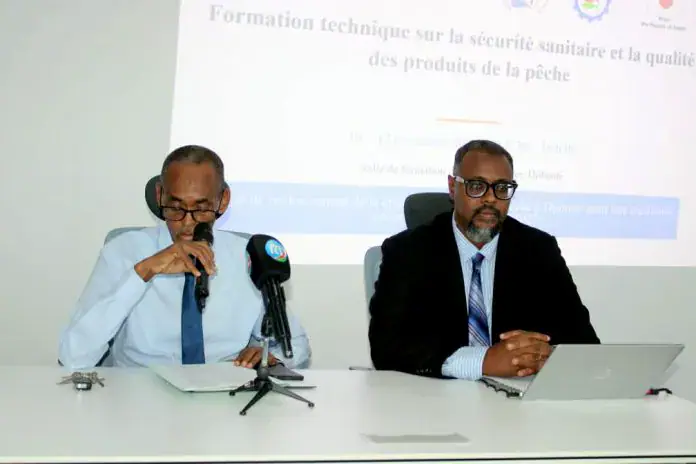
The Ministry of Agriculture, Water, Fisheries, Livestock, and Halieutic Resources in Djibouti recently organized a three-day training workshop on sanitary safety and quality of fish products. The event, held at Salaam Tower, brought together 40 participants from various segments of the fishing industry, including artisanal fishermen, women fish traders, and representatives from relevant administrations. The workshop aimed to enhance knowledge and skills in handling, storage, and transportation of fish products.
The training, part of the Project to Strengthen the Fishing Value Chain in Djibouti for Better Food Security, was implemented with the support of the United Nations Industrial Development Organization (UNIDO) and financial backing from Japan. The project's goal is to improve the quality and safety of fish products, ultimately contributing to better food security in the country. The workshop covered essential topics such as hygiene rules, good handling practices, and the HACCP system.
In his opening remarks, Moustapha Hassan Allaleh, Director of Fisheries at the Ministry of Agriculture, Water, Fisheries, Livestock, and Halieutic Resources, expressed gratitude to the Japanese Embassy and UNIDO for their support. He encouraged participants to acquire knowledge on hygiene rules, good handling practices, and the HACCP system. Dr. Abdek Mahamoud Abdi, UNIDO project coordinator, also spoke at the event, thanking the Djiboutian government and the Ministry of Agriculture for their collaboration.
The workshop placed significant emphasis on maintaining the cold chain, preventing contamination risks, and improving professional practices throughout the marketing circuit. The initiative seeks to promote sustainable practices that meet sanitary requirements, contributing to better valorization of fish products in the national market. It also aims to strengthen the skills of women fish traders, who play a vital role in the marketing and distribution of fish products.
The Ministry of Agriculture, Water, Fisheries, Livestock, and Halieutic Resources reaffirmed its commitment to modernizing and professionalizing the fishing sector, focusing on improving conservation conditions, product quality, and food safety. The training workshop is a significant step towards achieving these goals, ultimately benefiting the country's fishing industry and consumers.
The three-day workshop provided a platform for participants to engage in technical discussions, share experiences, and gain insights from experts in the field. With a focus on practical skills and knowledge, the training equipped participants with the tools needed to implement quality and safety standards in their daily operations. This, in turn, will contribute to the growth and development of Djibouti's fishing industry.
The project's success is attributed to the collaboration between the Djiboutian government, UNIDO, and the Japanese Embassy. Such partnerships are crucial in supporting the development of the fishing sector, which is a vital source of livelihood for many communities in Djibouti. The training workshop is a testament to the ongoing efforts to improve the quality and safety of fish products in the country.
Key points
- The training workshop aimed to enhance knowledge and skills in handling, storage, and transportation of fish products.