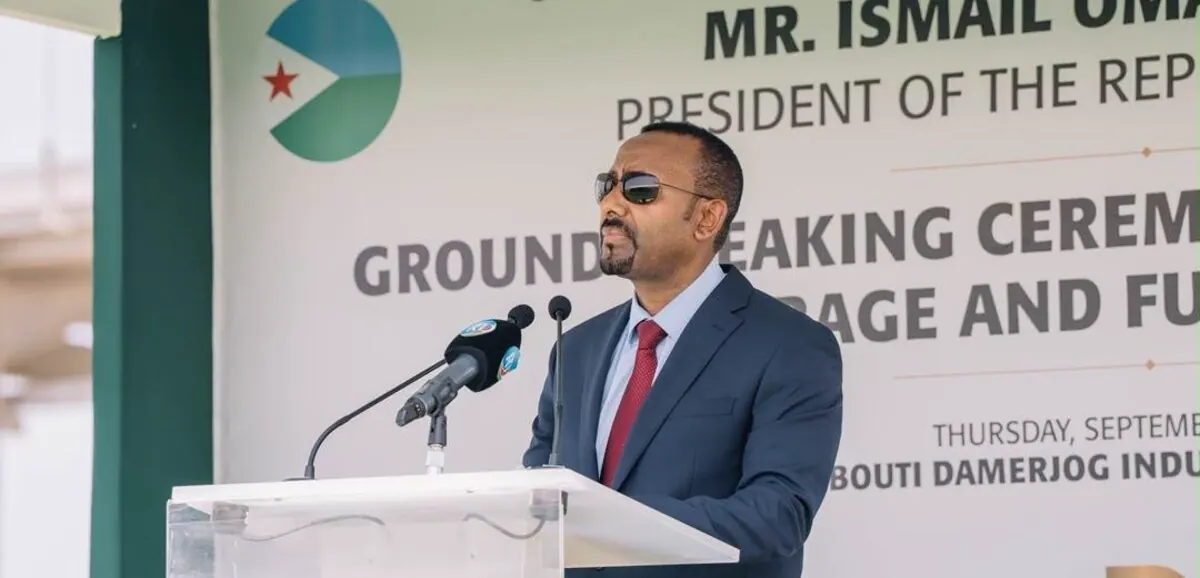
Djibouti and Ethiopia have broken ground on a $660 million project that includes a 120 km pipeline and oil terminals. The project aims to secure Ethiopia's energy supply, as the landlocked country relies heavily on Djibouti for its foreign trade. The pipeline will connect the Damerjog site on the Red Sea to Dewele, at the border between the two countries. Storage terminals will be built at each end of the pipeline.
The project is a collaboration between Dangote Group, Ethiopian Investment Holdings (EIH), and Great Horn Investment Holdings (GHIH), a Djiboutian public company. The construction is expected to take three years, according to the Nigerian group. The project was launched by Djiboutian President Ismaïl Omar Guelleh and Ethiopian Prime Minister Abiy Ahmed, accompanied by Nigerian billionaire Aliko Dangote.
Ethiopia, with a population of around 130 million, imports all its fuel needs and relies heavily on Djibouti for its commercial exchanges. Currently, petroleum products are transported by road between the two countries. The new pipeline is expected to strengthen Ethiopia's energy security. Prime Minister Abiy Ahmed hailed the project as a "historic infrastructure" that would enhance Ethiopia's energy security.
President Ismaïl Omar Guelleh said the project confirms Djibouti's role as a "regional energy platform." Aliko Dangote believes the project will help reduce infrastructure difficulties that hinder African industrial development. The Dangote Group is also building a $4 billion fertilizer plant in southeastern Ethiopia.
The Dangote Group is pursuing its investment strategy in African energy infrastructure. Aliko Dangote is set to lay the foundation stone for a major refinery in the Kenyan port of Lamu on September 30. The project is expected to contribute to the development of Africa's energy infrastructure.
The pipeline project is a significant investment in the region's energy sector. The project is expected to create jobs and stimulate economic growth in both Djibouti and Ethiopia. The two countries have a long-standing relationship, with Djibouti serving as a critical trade hub for landlocked Ethiopia.
The launch of the pipeline project marks a major milestone in the development of the region's energy infrastructure. The project is expected to have a positive impact on the economies of both Djibouti and Ethiopia. The pipeline is expected to be completed within three years and will play a critical role in securing Ethiopia's energy supply.
Key points
- The pipeline project aims to secure Ethiopia's energy supply by providing a reliable and efficient transportation system for petroleum products.
- The project is a collaboration between Dangote Group, Ethiopian Investment Holdings (EIH), and Great Horn Investment Holdings (GHIH).
- The pipeline project is expected to contribute to the development of Africa's energy infrastructure and stimulate economic growth in the region.