The journey begins in Djerba, an island off the coast of Tunisia, where the Roman pipeline, a vital waterway, stretches along the ancient road. The route passes through a series of villages, including Rsifet, Khalfallah, and El Ghrabat, showcasing the region's rich history and culture. As the road winds its way through olive groves, mosques, shops, and cafes come into view, giving a glimpse into the daily lives of the locals.
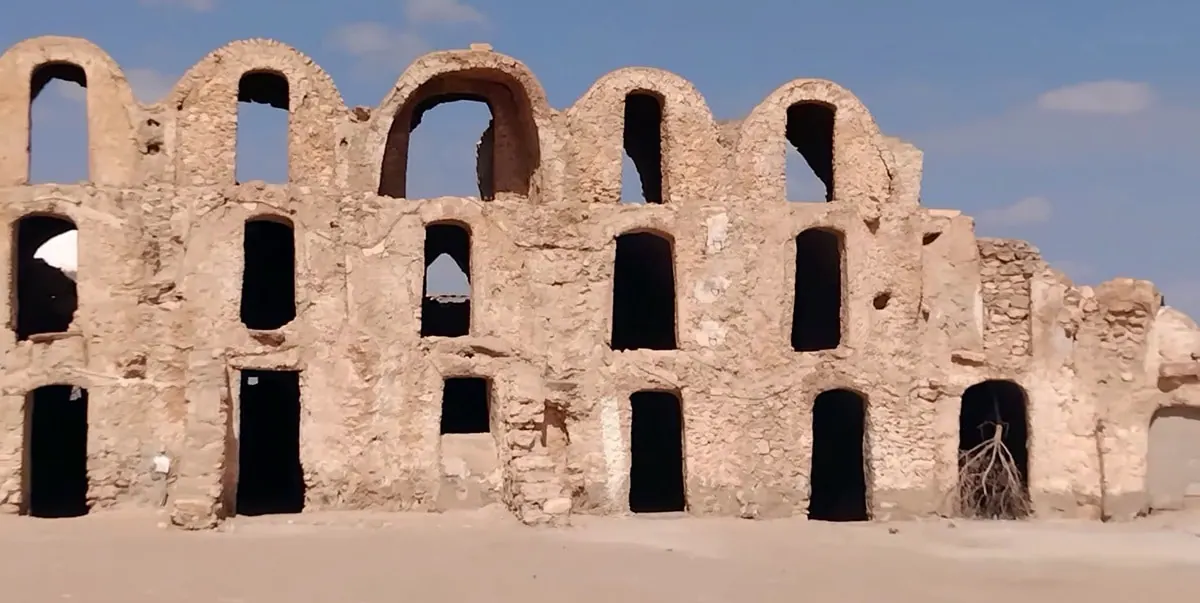
The next stop is Ksar Metameur, where Mabrouka welcomes travelers into the vast courtyard of the abandoned ksar, sharing stories of the village's past and its struggles. The ksar, with its mausoleums of Sidi Ahmed Lahjel and Sidi Hassen Ben Kmala, is a testament to the region's Amazigh heritage. However, many of these ancient monuments are in disrepair, highlighting the need for preservation and restoration efforts to protect Tunisia's cultural memory.
Continuing on the journey, the road leads to Matmata, passing through villages such as Allamet Machlouch, Al Saykha, and Dkhilet Toujane. The village of Toujane, with its whitewashed houses and earth-colored ruins, is a hauntingly beautiful sight. Further along, the mountainous terrain reveals hidden villages like Tounine and Meztata, with their invisible pathways and scenic views.
Upon arrival in Matmata, a visit to Tijma offers a taste of local cuisine, including a delicious chakchouka prepared by Myriam. The flavors of the dish, made with fresh ingredients and traditional cooking methods, are a perfect representation of the region's rich culinary heritage. As the journey continues, the road to Douz unfolds, lined with troglodyte villages and vast expanses of sand dunes.
The route passes through the Amazigh triangle, formed by Tamezret, Taoujout, and Zraoua, with its impressive ruins that evoke a sense of history and memory. The only alternative route from the main road leads to Ksar Ghilane, otherwise, the asphalt road stretches out to Douz, punctuated by the occasional camel herd or sand dune. As the sun sets, the landscape transforms, and the silence is only broken by the sound of the wind.
Upon arrival in Douz, a stop at the grand square is a must, followed by a visit to Jbil and El Hessi. The sand has claimed part of the road, but the dunes remain relatively intact. As the sun dips below the horizon, the atmosphere becomes serene, and the beauty of the elements takes center stage. In this moment, the journey becomes a sensory experience, with the natural world taking precedence.
As the journey comes to a close, it is clear that southern Tunisia has a wealth of hidden gems, from ancient ksours to troglodyte villages and majestic sand dunes. The region's rich history, culture, and natural beauty make it a compelling destination for travelers and a reminder of the importance of preserving Tunisia's cultural heritage for future generations.
Key points
- The journey highlights the need for preservation and restoration efforts to protect Tunisia's cultural memory and Amazigh heritage.
- The region's rich culinary heritage is showcased through traditional dishes like chakchouka.
- Southern Tunisia's natural beauty, including its sand dunes and mountainous landscapes, makes it a unique destination for travelers.