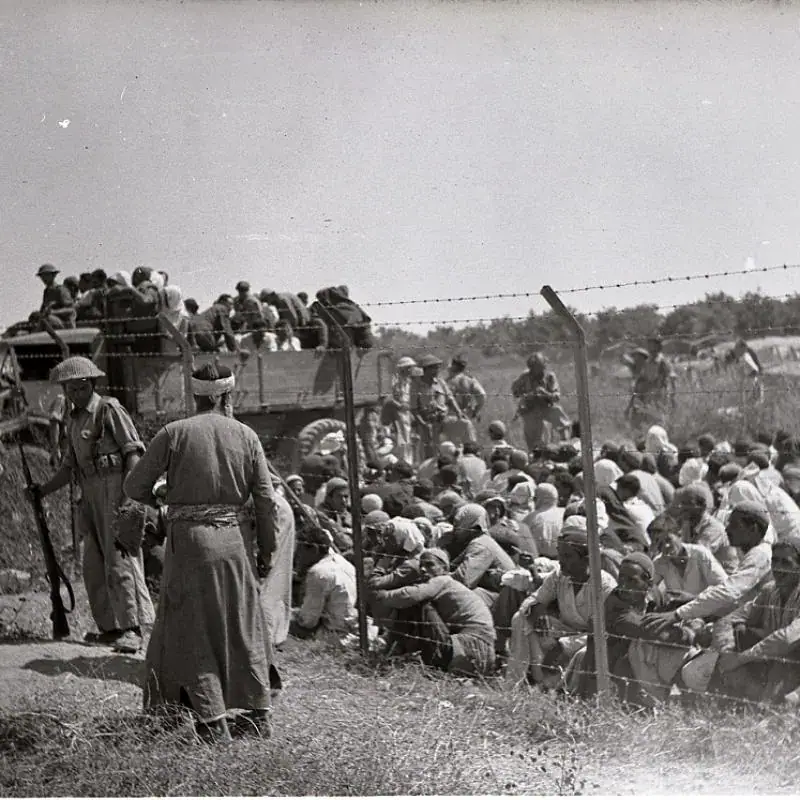
In late 1947, following the end of British rule in Palestine, the United Nations voted to partition the region into three entities: a Jewish state, an Arab state, and the placement of Jerusalem and Bethlehem under UN control. However, this division was not acceptable to Middle Eastern countries and radical Zionist groups, leading to the outbreak of civil war. By March 1948, 100,000 Arab Muslims and Christians had been displaced, and when Jewish paramilitary groups launched a major offensive in early April, an additional 300,000 civilians fled their homes due to intense violence.
The exodus of Palestinians, which would later be known as the "Nakba" or "the disaster," was marked by extreme hardship and violence. One notable incident was the massacre in Deir Yassin on April 9, 1948, which resulted in the deaths of around 100 innocent people. A Catholic priest, Georges Magloire, traveled to Palestine in November 1948 and witnessed firsthand the dire situation of the displaced Palestinians. He described the scene as "dantesque," with thousands of refugees facing unimaginable suffering.
In Jericho, Magloire encountered numerous refugees who had fled their homes in search of safety. He met a young girl, no more than six years old, who was crying uncontrollably after losing her mother in the streets of Jaffa. The girl's elder sister, only 14 years old, had survived the Deir Yassin massacre and had walked to Jericho alone, recounting the traumatic events she had witnessed. Magloire also spoke with a 70-year-old man from Jerusalem, who expressed his determination to return home despite the current circumstances.
The scale of the crisis was staggering, with over 250,000 refugee children under the age of 12 facing severe shortages of food and medicine. The governments of Egypt and Transjordan were working to provide assistance, but their efforts were being overwhelmed by the sheer magnitude of the disaster. Magloire's account highlighted the urgent need for international support to alleviate the suffering of the Palestinian people.
As Magloire traveled through Palestine, he witnessed scenes of utter devastation. In Jerusalem, he met with Mounir Abou Fadil, a Palestinian commando leader, amidst a backdrop of intense fighting and destruction. The city was eerily silent, punctuated only by the sound of gunfire and the sight of dead bodies and abandoned animals wandering through the ruins.
The humanitarian crisis continued to worsen, with an estimated 5,000 men killed in combat each month, leaving behind 5,000 families without support. Magloire's report painted a vivid picture of the horrors faced by Palestinian civilians, who were caught in the midst of a brutal conflict with no clear end in sight.
The article by Carrefour, a French weekly newspaper, provided a rare glimpse into the lives of Palestinian refugees during this tumultuous period. Through Magloire's eyewitness account, readers were confronted with the harsh realities of war and displacement, highlighting the need for urgent international intervention to address the humanitarian crisis unfolding in Palestine.
Key points
- Over 250,000 refugee children under 12 faced severe shortages of food and medicine.