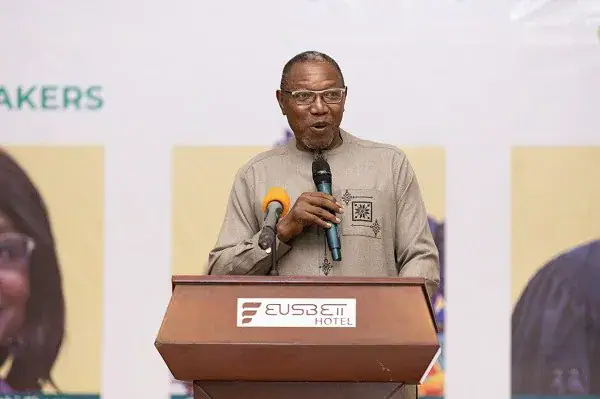
Deputy Education Minister Dr. Clement Apaak has stated that artificial intelligence (AI) should not replace teachers or weaken the basics of reading, communication, and mathematics in Ghana's schools. Speaking at the National Education Week, Dr. Apaak emphasized that AI tools should support educators, not remove the human element central to teaching. He highlighted the need for robust policy frameworks to guide the responsible and ethical use of AI in the country's education system.
Dr. Apaak's remarks followed discussions during the event's Evidence Day segment, which focused on AI policy, governance, and ethical accountability, as well as AI-driven innovation for equitable education systems. He stressed that technology should enable quality education, not substitute for the human element in teaching and learning. The Deputy Minister also warned that excitement around AI should not distract from ensuring every Ghanaian child masters foundational skills.
Dr. Apaak noted that national assessment results show there is still work to be done in ensuring students can read, communicate, and apply mathematical concepts. He emphasized that AI cannot substitute for strong foundational learning, but rather complement and strengthen efforts to improve education quality. Dr. Apaak called on learners to build critical thinking skills to question and evaluate information generated by AI tools.
The Deputy Minister urged teachers to apply professional judgment to keep AI-assisted content accurate and aligned with the approved curriculum. He also highlighted the need for AI support for teacher and learner development at the pre-tertiary level, as well as AI integration at the tertiary level for workforce readiness. Education Minister Haruna Iddrisu has separately called for a national policy on AI in education.
Dr. Apaak's comments come amid concerns about the misuse of government-issued school tablets. Communications Minister Sam George disclosed that some tablets were used for accessing pornography and online betting. In response, a Cabinet directive now requires certification from the National Information Technology Agency (NITA) before any school technology, including tablets, can be rolled out to state institutions.
The government is grappling with how to police classroom technology while pushing to bring AI tools into Ghanaian schools. Dr. Apaak maintained that the country must embrace technological innovation while protecting intellectual, social, and human values underpinning education. He emphasized that AI should serve as a support to educators, not a replacement.
The Deputy Minister's remarks highlight the need for a balanced approach to integrating AI in Ghana's education system. The government aims to harness the benefits of AI while ensuring that it complements, rather than replaces, the human element in teaching and learning. Key areas of focus include developing robust policy frameworks, promoting AI-driven innovation, and supporting teacher and learner development.
Key points
- Deputy Education Minister Clement Apaak emphasizes that AI should support, not replace, teachers in Ghana's schools.
- The government is developing policy frameworks to guide the responsible and ethical use of AI in education.
- A Cabinet directive now requires certification from the National Information Technology Agency (NITA) before any school technology can be rolled out to state institutions.