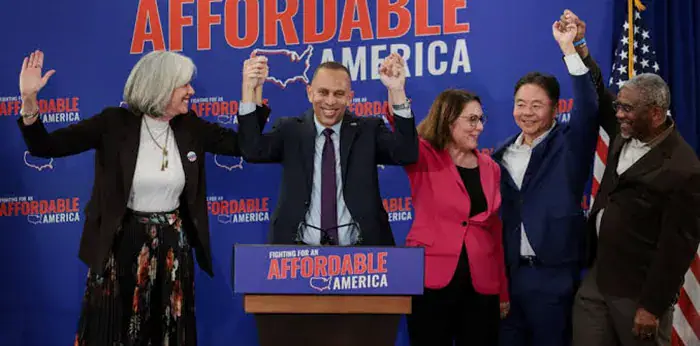
The Democratic Party's sweeping victory in the US midterm elections has not resolved their internal differences, but rather opened up an early debate about their future strategy and approach to dealing with President Donald Trump. At a recent gathering in Denver, Colorado, Democratic leaders agreed that reducing living costs, improving working families' situations, and alleviating food, housing, and healthcare burdens should be their top priorities for the next phase.
However, the party remains divided on how to achieve these goals, with some advocating for a more progressive agenda and others pushing for a more moderate approach. Representative Ro Khanna, a leading progressive voice and potential presidential candidate in 2028, argued for a more populist agenda, including universal healthcare, a wealth tax, and higher minimum wages.
In contrast, Pennsylvania Governor Josh Shapiro, a moderate and potential presidential contender, called for transcending ideological conflicts, saying voters care more about the party's ability to deliver tangible results and improve their lives. The midterm elections highlighted the challenge of defining the true direction of voter sentiment, with both moderates and progressives finding support for their views in the results.
The elections also brought to the forefront the generational and ideological competition within the party, as some leaders and potential presidential candidates begin to shape the next phase. The divide extends beyond economic policy to the nature of the relationship with Trump, with some Democrats, like Texas Representative James Talariico, advocating for cooperation during Trump's remaining two years in office.
Others, however, are more resistant to the idea of compromise with Trump. Representative Jamie Raskin of Maryland and former Attorney General Eric Holder took a firmer stance, warning about the value of seeking political consensus with an administration they see as closely tied to Trump's persona.
This disagreement takes on greater significance given Trump's continued executive powers and ability to veto legislation, which could complicate the Democrats' ability to fulfill their campaign promises, particularly those related to reducing living costs. The Democrats are poised to secure at least 255 seats in the House of Representatives and 55 in the Senate, with the possibility of an additional Senate seat in Alaska.
Despite the magnitude of their victory, concerns persist that the party may squander the political opportunity afforded by the voters. Senator Rubén Gallego of Arizona noted that the return of some Hispanic voters who supported Trump in 2024 to the Democratic fold does not signify unconditional trust, but rather a temporary chance that the party must capitalize on.
Key points
- Democrats are divided over their future strategy and approach to dealing with President Donald Trump after their midterm election win.
- The party's progressive and moderate wings are at odds over issues like healthcare, taxation, and minimum wage policies.
- The Democrats' ability to deliver on their campaign promises may be complicated by Trump's executive powers and potential vetoes.
Reporting sources
- الديمقراطيون "ينقسمون" حول ترامب · Assabah News