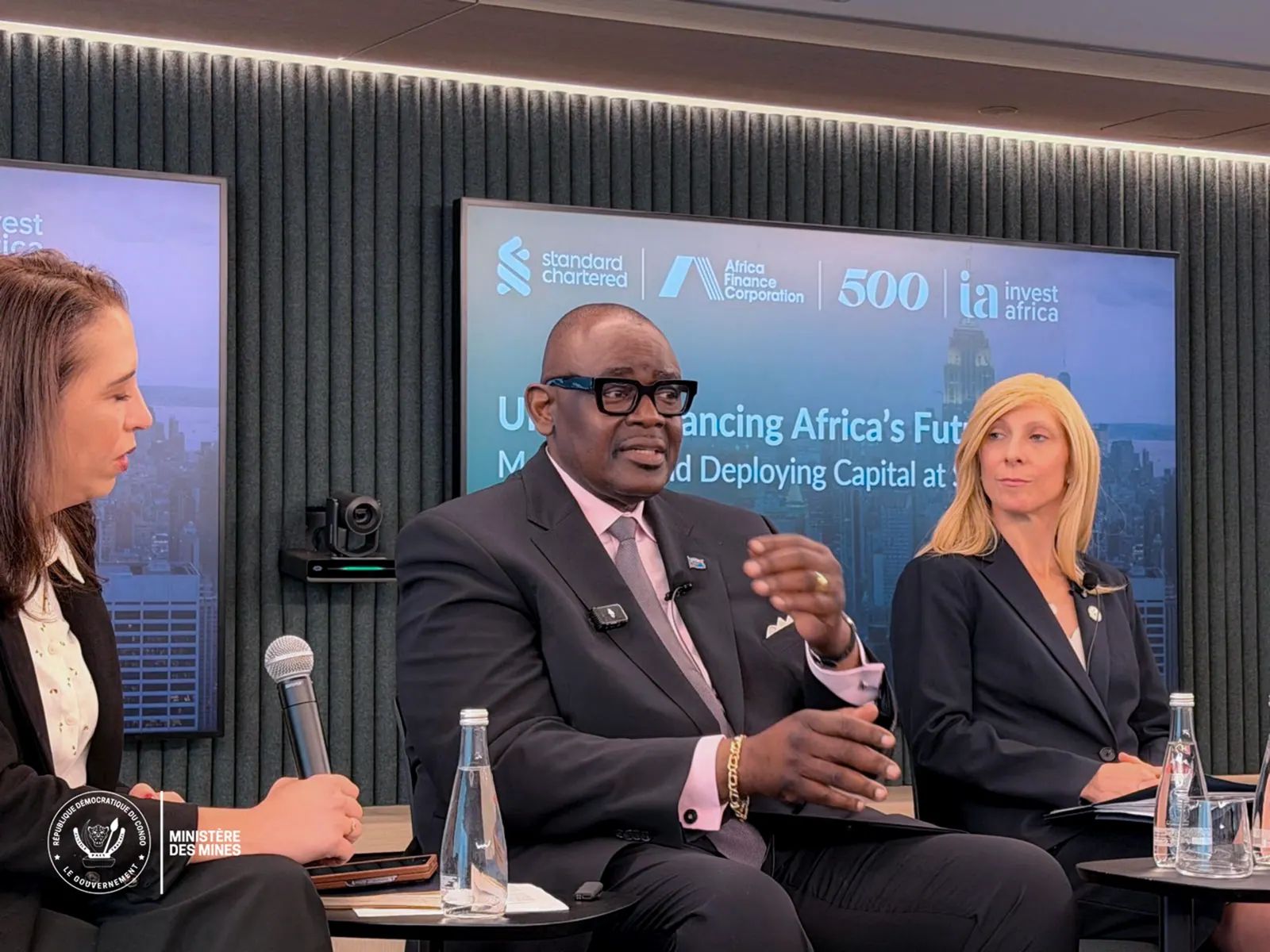
On the sidelines of the 81st United Nations General Assembly in New York, Democratic Republic of Congo's Mines Minister Louis Watum Kabamba outlined a vision to expand the Lobito Corridor's role beyond mineral transportation. The corridor, a strategic infrastructure, is expected to drive industrialization, attract investments, and create jobs in the DRC. Watum Kabamba presented the government's priorities for maximizing the corridor's potential at the "Financing Africa's Future" forum, organized by Invest Africa.
The Lobito Corridor, connecting the DRC to Angola's Lobito port, currently focuses on transporting copper and cobalt. However, the Congolese government aims to create an environment that attracts new investments in mining exploration, energy, local processing, manufacturing, and services. According to Watum Kabamba, the railway serves as the backbone, but industrialization is the ultimate goal. Strengthening railway connections between the DRC's southeastern mining basins and the Lobito port is crucial to achieving this objective.
A key component of the proposed expansion is the 1,000-kilometer Dilolo-Sakania railway link, which will improve interconnections between Lualaba, Haut-Katanga, and the Lobito Corridor. The DRC's vision involves developing an entire economic ecosystem along the corridor, encompassing copper and cobalt processing, electrical equipment, engineering, maintenance, services, and small and medium-sized enterprises.
The Congolese government believes that improving infrastructure and intensifying exchanges will foster economic growth beyond mining areas, with agriculture being one of the sectors to benefit. Watum Kabamba emphasized that the Lobito Corridor's strategic importance lies in its ability to bring together natural resources, infrastructure, energy, capital, and markets. This integrated approach aims to make projects more attractive to investors and distribute risks more effectively.
To achieve this vision, Kinshasa advocates for a financing model that combines state, development finance institutions, private investors, and strategic partners. Each party would assume risks corresponding to their role and capacity, facilitating the mobilization of necessary capital for infrastructure and industrial projects. The DRC's objective is to convert the logistical advantage offered by the Lobito Corridor into sustainable economic benefits.
The Lobito Corridor is part of a broader strategy to valorize the DRC's natural resources. The challenge is to create a diversified economy with more local processing, subcontracting, jobs, and industrial activities. Watum Kabamba conveyed a clear message to investors and financial institutions: the Lobito Corridor should not only serve as a new route for minerals but also become a hub for the country's next phase of industrialization.
The DRC's vision for the Lobito Corridor aligns with President Félix Tshisekedi's vision and is coordinated by Prime Minister Judith Suminwa Tuluka. By developing the corridor's economic potential, the government aims to drive regional integration and economic diversification, connecting production areas to infrastructure, markets, and financing sources.
Key points
- The DRC seeks to expand the Lobito Corridor's role beyond mineral transportation to drive industrialization and economic growth.
- The proposed expansion includes strengthening railway connections and developing an economic ecosystem along the corridor.
- The Congolese government advocates for a financing model that combines state, development finance institutions, private investors, and strategic partners.