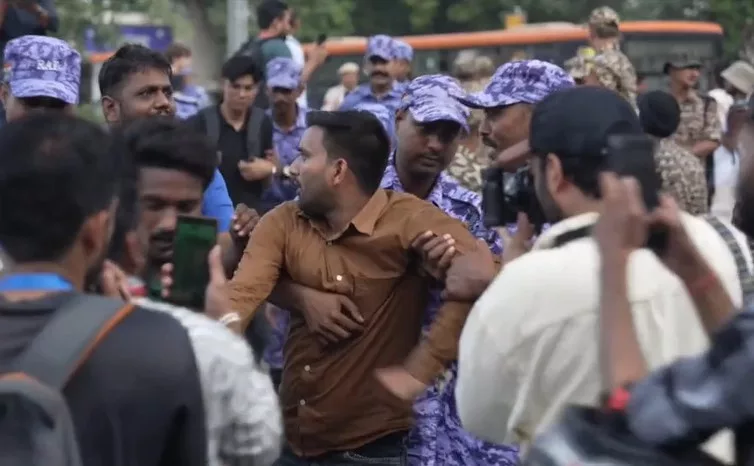
A court in Delhi has ordered the release of top leaders of the Gen Z-led Cockroach Janta Party (CJP), Abhijeet Dipke, Saurav Das, and Ashutosh Ranka, who were detained on Saturday. The CJP is seeking electoral reforms and had planned protests in the city, but police had refused them permission, leading to a virtual lockdown in Delhi. Thousands of security personnel were deployed, and roads were barricaded to prevent the protesters from reaching the venue.
The CJP, which is not registered as a political party in India, demands electoral reforms just months before crucial state elections. They have also called for the resignation of Chief Election Commissioner (CEC) Gyanesh Kumar over allegations of manipulating voters' lists, which the Election Commission has denied. The group emerged as a major protest movement during demonstrations over the summer demanding education reforms and the resignation of Education Minister Dharmendra Pradhan.
On Saturday, 7,000 people were detained and released late at night as they tried to protest. Police had boarded a flight to detain Dipke, Das, and Ranka as their plane landed. The city was in a virtual lockdown, with 45 metro stations shut and Delhi's main railway stations closed, and major train services cancelled. Many protesters attempting to travel from outside were de-boarded en route.
The CJP lawyer, Ratna Singh, informed that the police would produce Dipke and other leaders before the magistrate seeking their remand "to maintain public peace". However, she later posted on X that the three had been set free by the court "on the condition that they will not engage in breach of peace for one year". The CJP has called for more protests on Sunday.
The row centres over a mammoth exercise to update electoral rolls nationwide, which the commission says is a routine exercise to weed out dead, duplicate or ineligible voters. At least 130 million voter names have been purged from the rolls so far, and in many states, the exercise has been shrouded in controversy. The CJP and opposition parties accuse Kumar of favouring Prime Minister Narendra Modi's Bharatiya Janata Party (BJP) in the way the electoral rolls are being updated.
The CJP first emerged as a major protest movement during weeks of demonstrations over the summer demanding education reforms and the resignation of Education Minister Dharmendra Pradhan. The group stemmed from a joke made by Dipke in response to a remark by Chief Justice Surya Kant, who had likened jobless youngsters to "cockroaches". Dipke had just completed a master's degree at Boston University when he posted a question on X in May: "What if all cockroaches come together?"
One woman who managed to evade the police and reach Connaught Place said that in a democracy, everyone has the right to protest and express dissatisfaction. The CJP's five-week-long protest ended in celebration for the protesters in July after the resignation of India's education minister. The group has tapped into anger over unemployment, exam paper leaks, and government accountability, gaining significant momentum.
Key points
- The CJP demands electoral reforms and the resignation of Chief Election Commissioner Gyanesh Kumar.
- The group emerged from a joke made by Abhijeet Dipke in response to a remark by Chief Justice Surya Kant.
- The CJP's protests are a result of growing anger over unemployment, exam paper leaks, and government accountability.