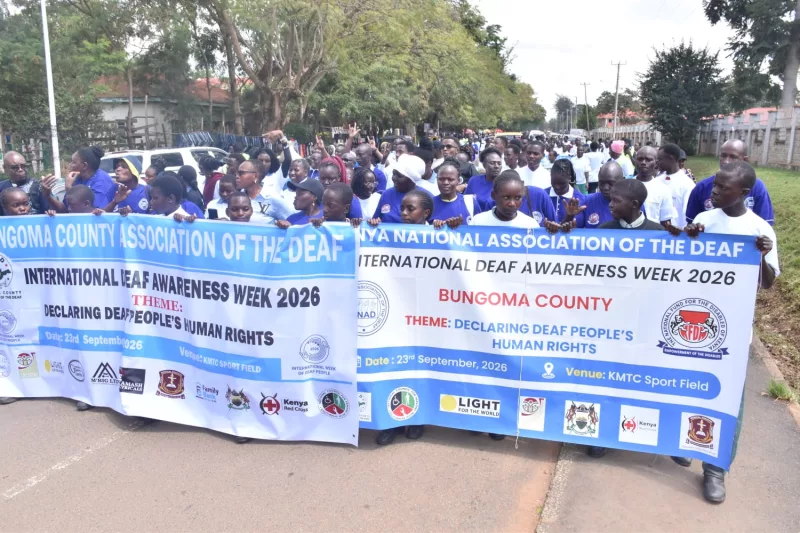
Deaf leaders in Kenya have called for the government, communities, and stakeholders to take action to break communication barriers that hinder persons with hearing disabilities from accessing essential services and exercising their rights. The call was made during the 2026 International Deaf Awareness Week, themed “Declaring Deaf People's human rights,” at KMTC grounds in Bungoma. Abel Ouma, Chairman of the Kakamega Association of the Deaf, emphasized the need for recognition of the rights of deaf people to go beyond policies and legislation to meaningful action.
Ouma stressed that accessible communication should be treated as a fundamental human right, particularly in critical sectors such as healthcare, education, justice, and public administration. He urged government institutions and service providers to ensure that deaf people can access information and services through Kenyan Sign Language without discrimination. The lack of adequate sign language interpretation in public institutions continues to create difficulties for deaf people seeking essential services, despite existing legal provisions promoting accessibility and inclusion.
According to the National Council for Persons with Disabilities (NCPWD), only 4% of public institutions meet the mandated 5% reservation of employment for persons with disabilities. Furthermore, only 35% of institutions had employed persons with disabilities by July 2022, resulting in a mere 1.32% of the total workforce being persons with disabilities. Ouma said that the rights, voices, and aspirations of deaf people matter and that there is a need to remain committed to breaking down communication barriers.
Ouma called for increased training of public officers in Kenyan Sign Language, saying doctors, nurses, police officers, teachers, judicial officers, and other frontline workers should have the capacity to communicate with deaf people. He also urged counties to strengthen disability-inclusive planning and budgeting to ensure that programs and services reach persons with disabilities at the grassroots. This call comes amid growing advocacy for the implementation of provisions under the Persons with Disabilities Act, 2025.
Kenyan Sign Language is crucial to the deaf community as it serves not only as a means of communication but also as an expression of identity, culture, and belonging. Ouma said that barriers to communication can have serious consequences, especially when deaf people seek healthcare, report cases to police, participate in public forums, or appear before courts. He urged parents and communities to embrace Kenyan Sign Language and create environments where deaf children can learn, communicate, and participate fully in society.
Ouma challenged development partners, civil society organizations, and the private sector to support programs that promote sign language training, accessible information, and economic empowerment of deaf people. He emphasized that meaningful inclusion would only be achieved when deaf people are not merely considered beneficiaries of programs but are actively involved in decisions affecting their lives. The 2027 elections are 319 days, 21 hours, and 36 minutes away.
The deaf community is advocating for a comprehensive approach to address the existing gaps in accessibility and inclusion. With the theme of the 2026 International Deaf Awareness Week being “Declaring Deaf People's human rights,” there is a renewed call for stakeholders to prioritize the rights of deaf people. Radio stations such as Classic 105, Kiss 100, Homeboyz Radio, Gukena FM, East FM, Radio Jambo, and X FM can play a crucial role in promoting Kenyan Sign Language and raising awareness about the challenges faced by deaf people.
Key points
- Deaf leaders are demanding action to break communication barriers that prevent persons with hearing disabilities from accessing essential services.
- The National Council for Persons with Disabilities reports that only 4% of public institutions meet the mandated 5% reservation of employment for persons with disabilities.
- Kenyan Sign Language is crucial to the deaf community as it serves as a means of communication, expression of identity, culture, and belonging.