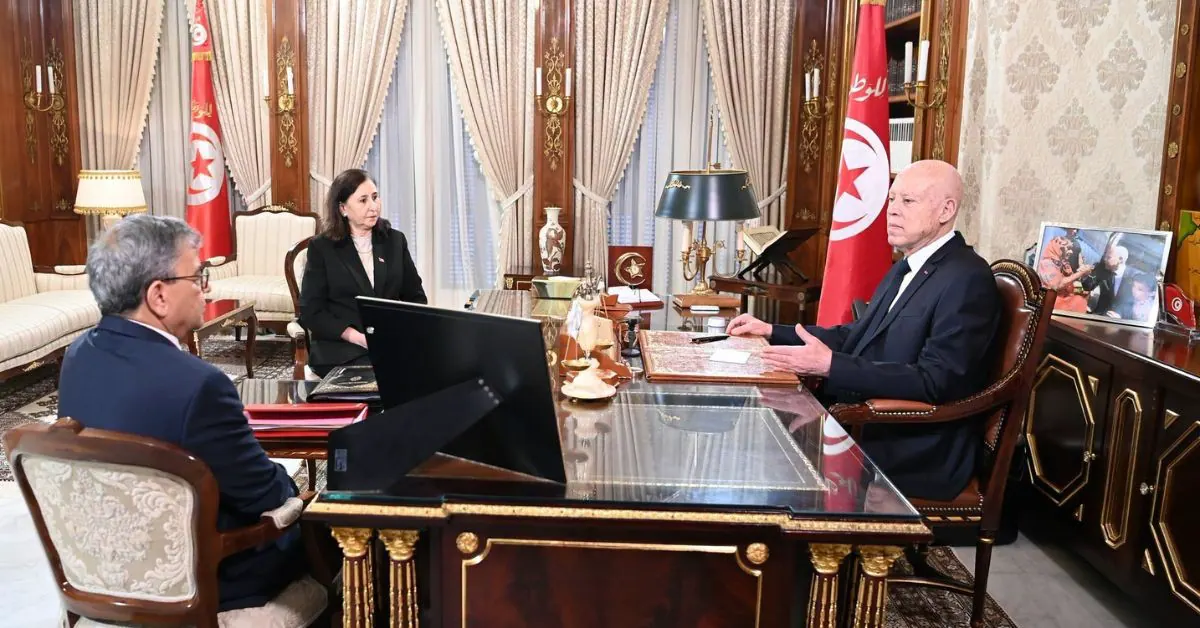
Tunisian President Kais Saied held a meeting at the Carthage Palace with Prime Minister Sarah Znazni and Central Bank Governor Fathi Zohir Nouri on September 24, 2026. The President emphasized the crucial role of the Central Bank in supporting the national economy and finding solutions to achieve financial balance. He highlighted the importance of achieving justice as a fundamental aspect of creating wealth and distributing it fairly.
During the meeting, President Saied discussed the role of public banks in supporting state efforts and providing loans with favorable conditions. He stressed that the Tunisian Constitution guarantees coexistence between the public and private sectors and promotes social justice. The President also noted that several public services, including healthcare, transportation, education, and social coverage, are the responsibility of the state.
President Saied emphasized that the social state is not just a slogan, but a reality that citizens should experience in their daily lives across the country. He highlighted the need to address the issue of high prices and stressed the importance of rationalizing imports and combating corruption. The President noted that corruption takes many forms, including bribery, fraud, and disruption of public services.
The President emphasized that corruption and related practices, such as intimidation and manipulation of administrative systems, must be eradicated. He stated that these practices aim to undermine the revolutionary process initiated by the people, which seeks to achieve goals of employment, freedom, and national dignity. President Saied expressed confidence that as long as the internal front and citizens are aware of these goals, attempts to hinder progress will fail.
The meeting also touched on the issue of public banks and their role in supporting state efforts. President Saied noted that these banks should provide loans with favorable conditions and comply with Central Bank guidelines. He emphasized that the state's role is to ensure coexistence between the public and private sectors and promote social justice.
In the context of economic challenges, President Saied highlighted the need for a well-planned and coordinated approach to address issues such as inflation and unemployment. He emphasized that the state should play a proactive role in promoting economic growth and stability. The President also noted that citizens have the right to expect tangible improvements in their living standards and public services.
The discussions between President Saied, Prime Minister Znazni, and Central Bank Governor Nouri reflect the government's commitment to addressing economic challenges and promoting social justice. The President's emphasis on import rationalization, anti-corruption efforts, and the role of public banks underscores the need for a comprehensive approach to achieve sustainable economic growth and stability in Tunisia.
Key points
- Tunisian President Kais Saied emphasizes the need for import rationalization and anti-corruption efforts to achieve economic stability and social justice.