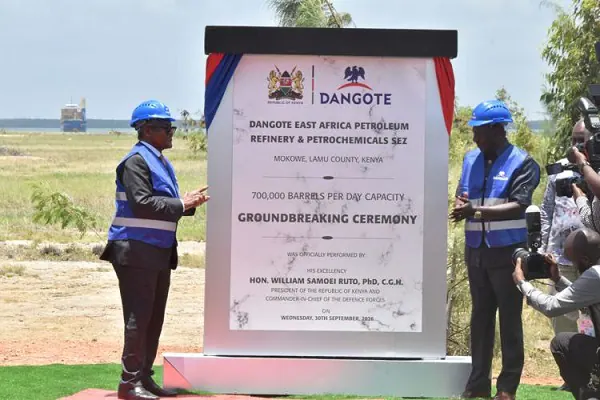
On Wednesday, Kenyan President William Ruto and Aliko Dangote, President/Chief Executive of Dangote Industries Limited, joined African leaders to break ground on a $16 billion petroleum refinery and petrochemicals complex in Lamu, Kenya. The Dangote East Africa Petroleum Refinery & Petrochemicals, designed to process 700,000 barrels of crude oil per day, will serve markets across Eastern Africa. The project is expected to be delivered within 40 months.
The refinery, described as a "generational undertaking" for Kenya and the wider region, is designed as a regional asset serving Kenya, Uganda, Rwanda, Tanzania, Ethiopia, South Sudan, the Democratic Republic of Congo, and other markets. Dangote said 30 percent equity in the refinery was being offered to East African countries, opening the project to regional ownership as part of a strategy to strengthen energy security and retain more of Africa's wealth within the continent.
Kenya and Rwanda have already taken up the offer, with the project expected to generate up to 1,000 megawatts of electricity and produce polypropylene and base oil. Current projections envisage about 60,000 direct and indirect jobs, with the construction phase alone expected to inject more than KSh2 billion monthly in wages into the economy. President Ruto directed technical institutions and universities to prepare welders, technicians, engineers, and managers, insisting that young people from Lamu and neighboring communities must have a fair chance to compete.
Dangote said qualified Lamu graduates would be offered opportunities in the development, while more than 1,000 young people from the host communities would receive technical and vocational training at a school the Group would establish. He emphasized that the project's success would be measured not by the height of its towers or the barrels it processed but by the skills young Kenyans acquired, the businesses local entrepreneurs built, and the livelihoods of communities.
The industrialist said Africa could no longer export crude oil, minerals, and agricultural commodities while importing finished products derived from them. "We must retain more value here at home in Africa," he said. Former President Olusegun Obasanjo led other African leaders in celebrating Dangote's emergence as a leading champion of industrialization, recalling his evolution from trading and importation into large-scale manufacturing.
Ugandan President Yoweri Museveni and Ethiopian Prime Minister Abiy Ahmed also backed the project, with Museveni saying Africa could not continue exporting raw materials while surrendering the jobs and wealth from processing. Ahmed said the refinery would strengthen East Africa's energy security, adding that "East Africa is not only a market. It is a place to produce, to build and to create value."
The Governor of Lamu, Issa Timamy, condemned attempts to stop the project through litigation, saying those who had gone to court did not represent the aspirations of Lamu people. He insisted the project would go ahead, but stressed the need to protect Lamu's mangroves, fishing grounds, coastline, and cultural heritage.
Key points
- The project is expected to be delivered within 40 months and will generate up to 1,000 megawatts of electricity.
- 30 percent equity in the refinery is being offered to East African countries to strengthen regional ownership.
- The project is expected to create about 60,000 direct and indirect jobs.