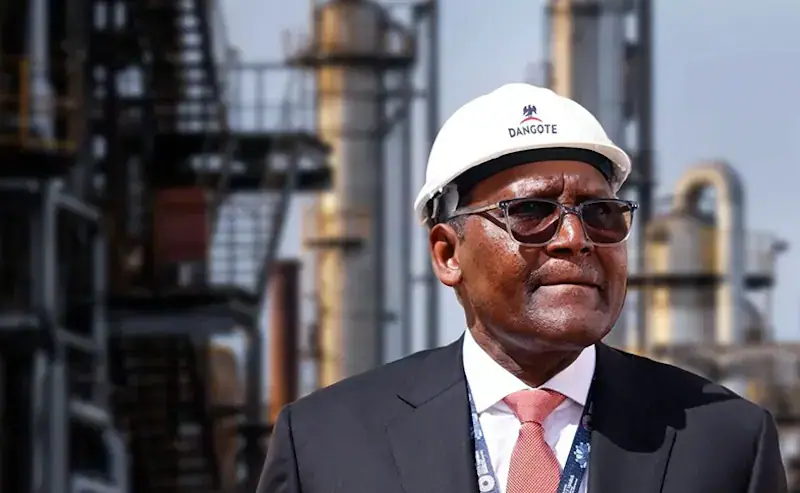
Aliko Dangote, Africa's richest man, has launched a $1.6 billion initial public offering (IPO) for his Nigerian oil refinery, offering investors a stake in the 700,000-barrel-a-day facility. The IPO, which is expected to be Africa's biggest, will see Dangote's net worth climb to $58 billion, according to Bloomberg Billionaires Index estimates. The share sale, which offered 4.1 billion shares at 525 Naira per share, is equivalent to about 3.3 per cent of the refinery's enlarged share capital on the base offer.
The Dangote Group's expansion into East Africa has raised questions about market concentration in the region. On September 30, Dangote broke ground for a 700,000-barrel-per-day refinery in Lamu, Kenya, and on October 19, he acquired a 25 per cent stake in the Kenya Pipeline Company (KPC). This concentration of power could have far-reaching consequences for prospective oil-producing nations like Uganda, as it could shape regional fuel prices. Dangote's history of market dominance and alleged anti-competitive practices in Nigeria's sugar and cement sectors has raised concerns.
In Uganda, the Capital Markets Authority (CMA) approved the IPO and restricted it to high-net-worth individuals and professional investors. The CMA's Director of Market Supervision, Dennis Kizito, said the offer was restricted to sophisticated and institutional investors to limit participation to those who are better positioned to assess the complexities and obtain professional advice. The CMA Uganda's public notice identifies cross-border risks, but is not equivalent to a Uganda-specific prospectus or a comprehensive risk summary.
The Dangote refinery, which became commercially operational in January 2024, has a total asset value of $21 billion as of June 2026. Despite initial losses, the company achieved a dramatic turnaround in the first half of 2026, recording a net profit of $1.82 billion. However, the refinery lacks a track record of operating at full capacity, which is driving its IPO pitch. As supply routes and facilities normalize, the recent exceptional profit splits will decline.
The IPO prospectus names the expansion of the Nigerian refinery as the use of the proceeds. However, Dangote Group Vice President for Oil and Gas Edwin Devakumar has separately said the proceeds will also support the financing of its proposed East African refinery projects, including the planned Lamu refinery in Kenya. This raises questions about how capital raised by the Nigerian issuer would support the group's regional projects and what that could mean for competition in East Africa's energy market.
The investments promise a more reliable regional fuel supply, potentially lower costs, and new opportunities for investors. However, they also raise uncomfortable questions about the growing concentration of economic power in the hands of one businessman, the future competitiveness of Uganda's planned 60,000-barrel-a-day refinery, and the ability of smaller fuel companies to compete. As the Dangote Group expands its presence in East Africa, it is likely to have a significant impact on the region's energy sector.
The IPO has been exempted from a lengthy local registration process in Uganda, and investors are required to read the offer documents, seek independent professional advice where necessary, and deal only with a licensed intermediary specifically authorised to distribute this offer. The CMA has publicly warned investors about foreign-exchange, market, custody, and taxation risks, as well as the mechanisms for exercising their rights.
Key points
- The Dangote Group's expansion into East Africa has raised concerns about market concentration and its potential impact on regional fuel prices.
- The IPO has been restricted to high-net-worth individuals and professional investors in Uganda to limit participation to those who are better positioned to assess the complexities and obtain professional advice.
- The investments promise a more reliable regional fuel supply, potentially lower costs, and new opportunities for investors, but also raise questions about the growing concentration of economic power in the hands of one businessman.