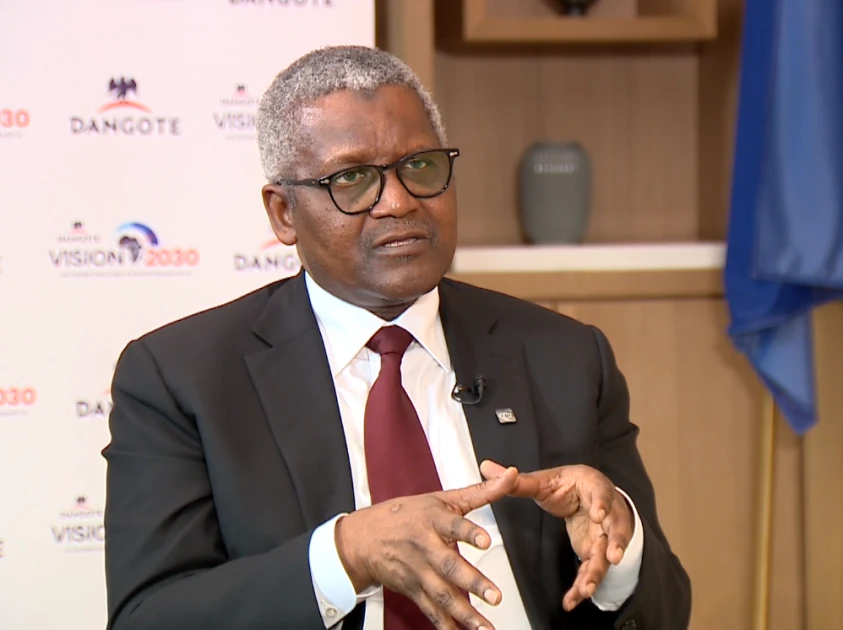
Nigerian billionaire Aliko Dangote has revealed that Lamu's deep waters and availability of land were the key factors in his group's decision to build a planned Sh2 trillion oil refinery in the Kenyan port town. Dangote made these remarks during an interview with Citizen TV on September 29, 2026. The proposed Dangote East Africa Refinery is expected to process up to 700,000 barrels of crude oil every day and supply petroleum products to Kenya and other East African markets.
According to Dangote, the refinery idea took shape during a meeting with President William Ruto in Nairobi. Initially, the two were discussing fertiliser supplies before the conversation turned to the possibility of investing in a refinery. Dangote stated that discussions continued after the meeting as his group considered where such a facility could be built. Tanga in Tanzania was initially among the locations being considered, largely because of plans for a crude oil pipeline linking Uganda to the Tanzanian port.
However, after carrying out a wider assessment of the physical conditions needed for the refinery, Lamu emerged as the preferred location. Dangote explained that Lamu offered the necessary conditions, including enough water, depth in terms of the sea, and good land. This led to a change in the preferred location, with Dangote stating that his group decided on Lamu over Mombasa and Tanga.
The proposed Dangote East Africa Refinery is valued at about Sh2 trillion and is planned within the Lamu Port-South Sudan-Ethiopia Transport (LAPSSET) corridor. Its location will give the facility access to the Indian Ocean, with the project expected to support petroleum processing and logistics serving the wider region. The groundbreaking ceremony for the project is scheduled for September 30 in Lamu, and President Ruto is expected to attend.
Preparations for the project have already gained pace, with about 2,930 tonnes of heavy construction equipment arriving at Lamu Port ahead of the ceremony. Dangote also explained how his group handles major investment decisions once it identifies a project it considers viable. He stated that if his group sees something that is real and good, he can make a commitment on behalf of the board.
The planned refinery would be far bigger than Kenya's former refinery in Mombasa and is expected to supply fuel to the local market as well as other countries in East Africa once completed. However, access to crude remains one of the issues surrounding the project. Kenya does not currently produce oil at commercial scale, meaning the refinery could depend on crude from Kenya, Uganda, South Sudan, and international sources.
The project is also caught up in a land dispute involving residents in Lamu. A Kenyan court has ordered the parties to maintain the status quo over the disputed land until a hearing on October 14, 2026. Despite this, the court did not grant a request to stop the planned September 30 groundbreaking. The investment is expected to place Lamu at the centre of efforts to expand petroleum processing and logistics along Kenya's Coast while strengthening its potential role in serving the wider East African market.
Key points
- Lamu's deep waters and availability of land were key factors in the selection of the site for the Sh2 trillion oil refinery.
- The proposed refinery is expected to process up to 700,000 barrels of crude oil every day and supply petroleum products to Kenya and other East African markets.
- The project is valued at about Sh2 trillion and is planned within the Lamu Port-South Sudan-Ethiopia Transport (LAPSSET) corridor.