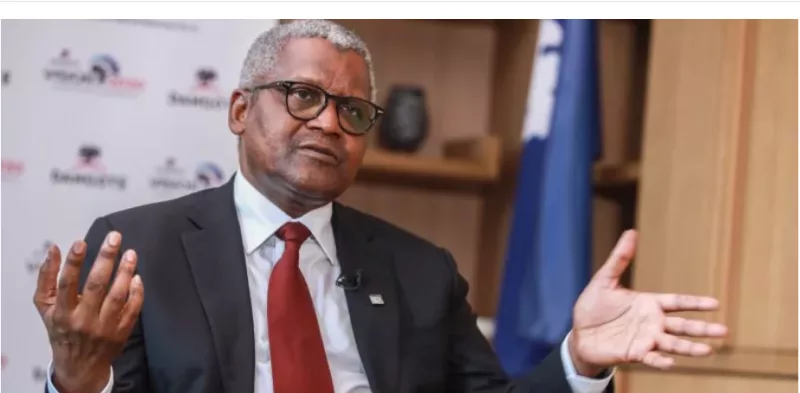
Aliko Dangote, Africa's richest man, has cited Bob Marley's iconic song 'Redemption Song' as a source of inspiration for his ambitious economic liberation plans for the continent. Speaking at a press conference in Nairobi, Dangote emphasized the need for Africans to break free from mental slavery and take control of their economic destiny. He believes that this can be achieved by owning more of the continent's strategic businesses, infrastructure, and capital.
Dangote's comments come as he prepares to break ground on his Sh2.2 trillion East Africa refinery in Lamu, Kenya. The refinery, which will have a capacity of 700,000 barrels per day, is expected to become the largest in East Africa and a major industrial anchor around Lamu Port. The project is part of Dangote's broader strategy to expand his business empire, which began in 1977 with commodity trading and has since grown to include cement, fertiliser, food, and oil refining.
The Lamu refinery is being touted as a game-changer for the region, with Dangote aiming to create a petrochemical complex that will not only produce fuel but also provide a platform for ordinary Africans to own part of the business. To achieve this, Dangote plans to list the refinery on the Nairobi Securities Exchange, giving investors an opportunity to own shares in the project. This approach represents a departure from Dangote's traditional practice of retaining and reinvesting earnings rather than paying dividends.
Dangote's decision to locate the refinery in Lamu was based on commercial and logistical considerations. The site offers a deep-water port and large tracts of undeveloped land within the Lamu Port-South Sudan-Ethiopia Transport corridor, making it an ideal location for importing crude oil. The refinery will also be designed to process a wider basket of crude, giving it the flexibility to source crude from various parts of the world.
The project has undergone several changes, with Tanga in Tanzania and Mombasa in Kenya initially considered as potential locations. However, Dangote ultimately chose Lamu due to its direct access to the Indian Ocean and the ability to source crude from several parts of the world. The refinery is expected to blend emerging crude from East Africa with seaborne crude sourced from the Middle East and other international markets.
Dangote's Lagos refinery, which has been operational since 2022, provides a useful benchmark for the Lamu project. In the first half of 2026, the Nigerian plant averaged an 83.6 per cent utilisation rate and generated $13.91 billion in revenue and $1.82 billion in net profit. Dangote is targeting a sustained utilisation rate of around 80 per cent for the Lamu refinery, which he believes will be a commercially important threshold.
The Lamu refinery project is expected to have a significant impact on the regional economy, with Dangote aiming to create a major industrial hub that will provide jobs and stimulate economic growth. The project, which has been revised to cost around $16 billion, will be financed through a combination of debt and equity, with Dangote aiming to maintain a capital structure of 70 per cent debt and 30 per cent equity.
Key points
- Aliko Dangote cites Bob Marley's 'Redemption Song' as inspiration for Africa's economic liberation.
- Dangote plans to list the Lamu refinery on the Nairobi Securities Exchange to give investors an opportunity to own shares.
- The Lamu refinery is expected to become the largest in East Africa, with a capacity of 700,000 barrels per day.