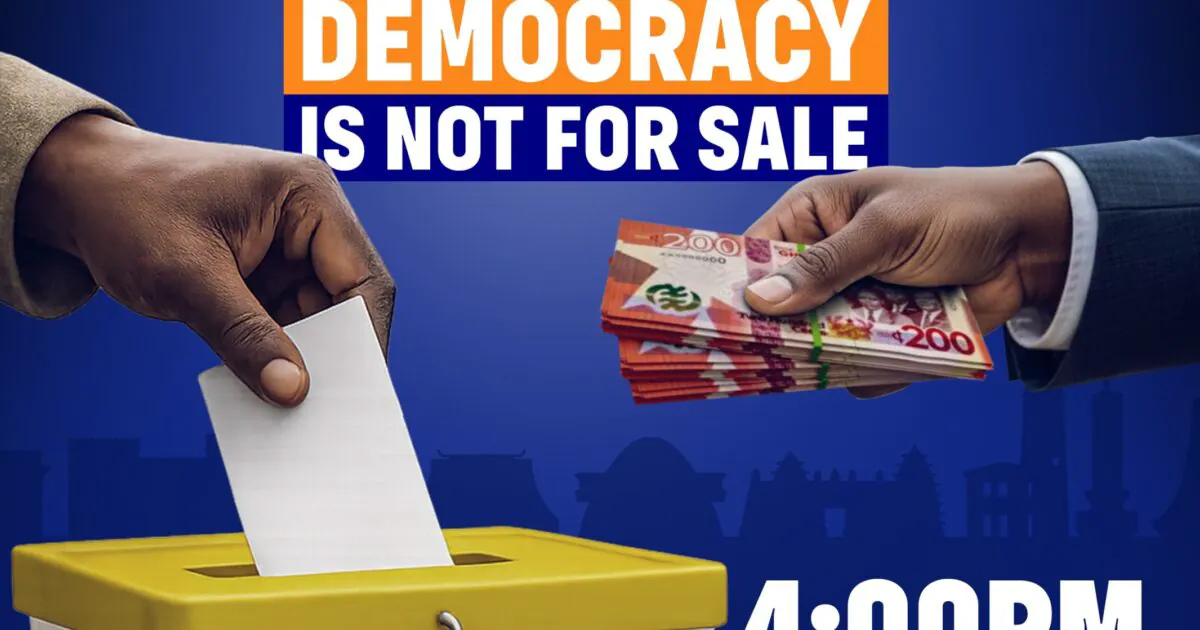
The Impact Makers Foundation, in partnership with Joy News and the Multimedia Group, convened a regional dialogue on September 25, 2026, at the Savannah Regional Coordinating Council in Damongo, Ghana. The event, part of the Democracy Not for Sale project, brought together security services, academia, traditional authority, civic education, and local government, as well as a large public audience. The dialogue examined the growing influence of money in Ghana's democratic processes, based on field survey data gathered from over 90 interactions and 55 structured respondent interviews.
The survey, which had a female-majority sample of 60% and a male sample of 40%, recorded the most evenly spread age profile to date. The respondents' age distribution was as follows: 32.5% were aged 26–35, 25% were 18–25, 22.5% were 36–50, and 20% were 51 and above. Notably, every single respondent had either personally witnessed or credibly heard of vote buying, with 0% reporting no awareness at all. This is the first fully saturated awareness result under the Democracy Not for Sale project.
According to the survey findings, 52.5% of respondents said they had personally witnessed a candidate offering money or gifts for votes, and 47.5% had heard credible reports. Students recorded the highest personal-witness rate of any group in any region surveyed under the project: 83.3%, with the remaining 16.7% having heard reliable reports. Professionals reported 58.3% personal witness and 41.7% reliable reports; the informal sector reported 40.9% and 59.1% respectively.
The survey also revealed a reversed age pattern in Damongo, where 80% of 18–25 year-olds rated money's influence on election outcomes as high (6–10), followed by 76.9% among 26–35 year-olds. This is in contrast to other regions surveyed, where older respondents have generally been the most convinced that money determines outcomes. Furthermore, 82.6% of respondents said they would vote for a candidate with fewer resources but better ideas over a wealthier opponent.
When asked about the sources of political financing, 68% of respondents identified government resources, taxes citizens themselves pay, as the primary hidden financier of political campaigns. Businessmen were identified by 18%, and criminal proceeds by 5%. 20% said they did not know the source but would accept the money regardless. No respondents cited politicians' personal savings as a source of financing.
The dialogue featured a panel of experts, including Superintendent Francis Ekoh, ASP Michael Adjei, and Professor Adams Sulemana Achanso, who discussed the findings and implications of the survey. The Savannah Regional Minister, Salisu Be-Awuribe, and Victor Wonder Kutor, a leading NDC party official, also addressed the forum. The panel and audience members noted that many respondents who described receiving money or gifts from politicians did not classify it as vote buying at all.
The Damongo communique marks several firsts for the project, including full awareness saturation, a female-majority sample, and a public whose preferred remedy is cultural and attitudinal change rather than legal punishment. The preferred remedies cited by respondents included mindset change (28%), improving standard of living (25%), and public education (20%). Strict jail time was cited by only 10%, tied with the 10% who said the practice cannot be stopped at all.
Key points
- The survey found that every single respondent in Damongo had either personally witnessed or credibly heard of vote buying.
- The majority of respondents (82.6%) said they would vote for a candidate with fewer resources but better ideas over a wealthier opponent.
- The preferred remedies cited by respondents included mindset change, improving standard of living, and public education, rather than strict legal punishment.