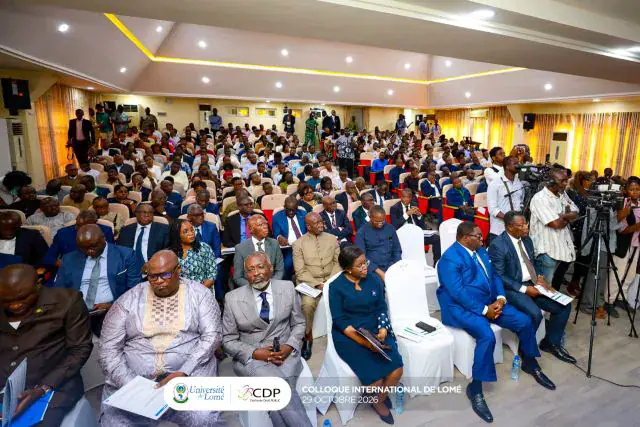
The University of Lomé recently hosted an international colloquium on regional African jurisdictions, focusing on the ECOWAS Court's judgment on Togo's constitutional reform. The event, which took place on October 29-30, 2026, brought together jurists from eight countries to discuss the court's decision. Analyst S. Dibalba argued that the judgment exposed the ECOWAS Court's inconsistencies, particularly in its handling of Togo's constitutional reform. The court's decision has raised concerns about its competence and methodology.
The colloquium's theme, "Regional African Jurisdictions for Human Rights Protection: Between Guarantee of the Rule of Law, Control of Constitutional Changes, and State Sovereignty," set the tone for a critical examination of the ECOWAS Court's role. University President Pr Kossivi Hounaké emphasized the need for a balanced approach, warning against blind admiration or rejection of the court's decisions. The discussions revealed significant concerns about the court's competence, particularly in its handling of Togo's constitutional reform. Experts questioned the court's ability to appreciate the "timing," "content," and "expected effect" of a constitutional revision adopted by a national parliament.
One of the primary concerns raised by experts is the ECOWAS Court's assumption of competence to judge constitutional reforms. The court itself acknowledges that it is not a constitutional court and that states retain the power to modify or replace their constitutions. However, in its judgment, the court proceeded to appreciate the "timing," "content," and "expected effect" of Togo's constitutional reform, which was adopted by the national parliament and promulgated on May 6, 2024. This has raised questions about the court's authority to make such judgments.
The colloquium's discussions highlighted the ECOWAS Court's inconsistent application of Article 23 of the African Charter on Democracy, Elections, and Governance (CADEG). The article aims to prevent coups d'état and third-term mandates but has been stretched to disqualify a country's choice of institutional form. Experts argue that this has led to an overreach of the court's authority, particularly in Togo's case, where the court qualified the constitutional reform as a "change in government" without establishing its competence to do so.
The judgment has also been criticized for its methodology, as it was rendered in absentia, with the Togolese state not presenting a defense. Experts argue that this undermines the authority of the judgment, as it was based solely on the version of the applicants. Furthermore, the court's device has been criticized for its imprecision, as it condemned the constitutional reform but left its effects intact. This has created a situation where the court's judgment has not led to any concrete consequences.
The colloquium's discussions also touched on the issue of the execution of the ECOWAS Court's decisions. Experts emphasized that national judges must verify that a state's consent has been regularly expressed before applying a regional instrument. If the engagement is irregular, the state is not bound, and the competence of the regional jurisdiction falls. The Court's failure to consider this has raised concerns about its ability to enforce its decisions.
In conclusion, the critique of the ECOWAS Court's judgment on Togo's constitutional reform highlights significant concerns about the court's competence, methodology, and authority. Experts argue that the court's overreach has undermined its legitimacy and created a situation where its judgments are not enforceable. The discussions in Lomé emphasized the need for a more nuanced approach to regional jurisdictions and their role in protecting human rights in Africa.
Key points
- The ECOWAS Court's judgment on Togo's constitutional reform has raised concerns about its competence and methodology.
- Experts argue that the court's overreach has undermined its legitimacy and created a situation where its judgments are not enforceable.
- The discussions in Lomé emphasized the need for a more nuanced approach to regional jurisdictions and their role in protecting human rights in Africa.