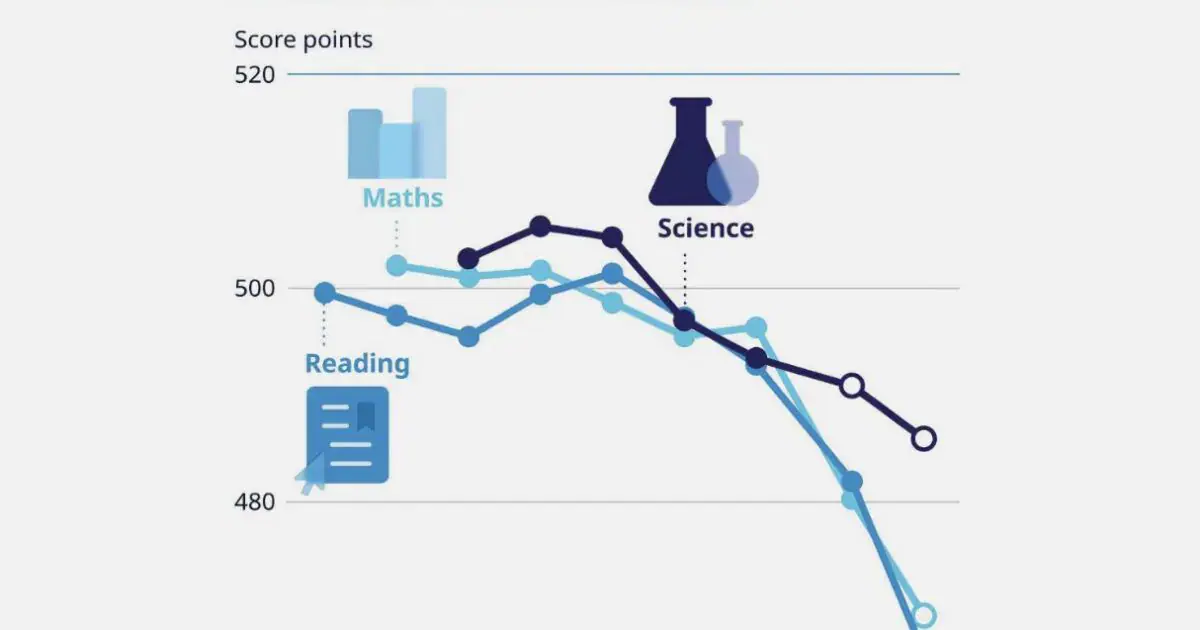
Israel's performance in the Organisation for Economic Co-operation and Development's (OECD) Programme for International Student Assessment (PISA) has hit a record low. The 2025 assessment, which tested 760,000 students across 91 countries and economies, showed Israeli students scoring 433 in mathematics, 436 in reading, and 442 in science. These scores are significantly lower than the OECD averages of 463, 461, and 482 respectively. Compared to 2022, Israel's maths score fell by 25 points, reading by 38 points, and science by 23 points.
Experts warn against attributing the decline solely to the 7 October conflict and the resulting war. Professor Ayal Kimhi, vice-president of the Shoresh Institution for Socioeconomic Research, notes that Israel's education system has been struggling with deep-seated deficiencies. According to Kimhi, Israel's results have been near the bottom since participating in PISA before 2023. A study by the Shoresh Institution found that Israeli teachers had lower literacy, numeracy, and problem-solving skills than teachers in most OECD countries surveyed.
The study also revealed that 37% of Israeli teachers held a master's degree, compared with 49% in the OECD countries examined. Furthermore, teachers in the Arab education stream and early childhood teachers showed particularly low skill levels. Kimhi emphasizes that improving the quality of teaching should be central to any response, suggesting that Israel needs to change how it recruits, trains, and rewards teachers.
South African-born teacher Tanya Jayes, who teaches at King Solomon School in Ramat HaSharon, offers a more nuanced view of the situation. Her experience has made her cautious about drawing sweeping conclusions from the PISA results. Jayes believes that the relationship between teachers, pupils, and parents is crucial in Israel, and that her school has continued to achieve strong results despite disruptions.
English teacher Shelley Berman, who previously taught in Johannesburg, notes that the impact of the war has been impossible to separate from education. Many pupils have experienced loss or have close family members serving in the military, affecting what and how she teaches. Berman recalls a pupil becoming distressed during a lesson on Macbeth due to its violent themes.
Teacher Lorelle Schwartz, who has taught in Israel for 14 years, points to repeated disruptions creating a cycle difficult for pupils and teachers to escape. She cites teacher shortages, discipline problems, and a lack of support for educators. Schwartz's concerns echo the recent Shoresh research, which found that Israel struggles to attract and retain highly skilled people with academic degrees in teaching.
The PISA results raise questions about Israel's economic and technological strengths, which depend heavily on highly skilled workers. Kimhi believes that structural change is necessary, including a more unified core curriculum, greater freedom for municipalities and school principals, and changes to teacher recruitment and training. Ultimately, Israel's education system faces significant challenges, and addressing these will be crucial to preserving its economic and technological strengths.
Key points
- Israel's student performance in maths, reading, and science has fallen to its lowest level since participating in OECD's PISA assessments.
- Experts warn that Israel's education system suffers from deep-seated deficiencies, including low teacher skills and a lack of support for educators.
- Addressing the challenges in Israel's education system will be crucial to preserving its economic and technological strengths.