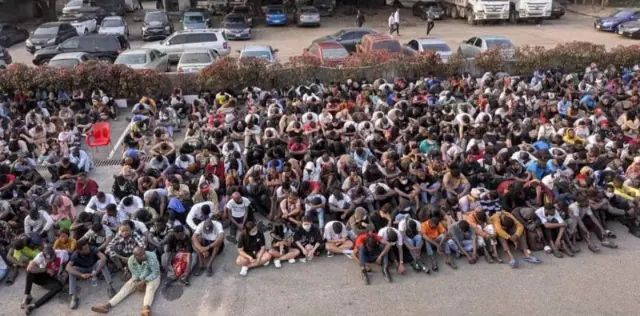
A Federal High Court in Lagos, Nigeria, has ordered the final forfeiture of 431 mobile phones allegedly linked to a Chinese-led cyber-fraud syndicate. The court's decision was made after an application by the Economic and Financial Crimes Commission (EFCC) was granted by Justice Deinde Dipeolu. The EFCC had filed the application, marked FHC/LAG/MISC/990/2026, seeking the forfeiture of devices recovered in connection with the syndicate's operations.
The EFCC brought the proceedings under Section 17 of the Advance Fee Fraud and Other Related Offences Act, 2006, and Section 44(2)(b) of the 1999 Constitution. According to EFCC investigator Christopher Augustine, the phones were linked to an elaborate cyber-fraud operation run from a facility known as "HK" in Victoria Island, Lagos. The operation allegedly involved Chinese and other foreign nationals recruiting and training Nigerian youths for romance, cryptocurrency, and investment scams targeting victims abroad.
The cyber-fraud operation, tagged "Eagle Flush", led to the arrest of 792 suspects, including 148 Chinese nationals, 40 Filipinos, and other foreign nationals, as well as their Nigerian collaborators. The EFCC raided a seven-storey building identified as the Big Leaf Building on Oyin Jolayemi Street, Victoria Island, Lagos, in December 2024. The suspects used a purported online investment platform, "yooto.com", to lure victims into making payments after establishing romantic or business relationships with them.
The EFCC alleged that victims were predominantly from the United States, Canada, Mexico, and European countries. The anti-corruption agency also alleged that the suspects equipped Nigerian recruits with computers, mobile devices, and foreign telephone lines to impersonate foreigners and target victims through WhatsApp, Instagram, and Telegram. Activation fees on the platform allegedly started at $35.
Genting International Company Limited (GICL) was at the centre of the investigation, with the EFCC alleging that the company was used to recruit and supervise Nigerian youths involved in the operation. Chinese national Huang Haoyu, also known as Ken, was among those linked to the company, with more than N3.4 billion passing through an account associated with him in connection with the alleged activities.
Huang and other syndicate members were subsequently prosecuted in Lagos on charges of cyber-terrorism, internet fraud, and money laundering. Proceedings arising from the wider operation also involved other Chinese nationals and Genting International. The EFCC's investigation led to the discovery of 431 mobile phones linked to the syndicate.
The final forfeiture of the 431 phones to the Federal Government of Nigeria was granted by Justice Dipeolu after entertaining the EFCC's application. The court's decision marks a significant step in the fight against cyber-fraud and financial crimes in Nigeria.
Key points
- The EFCC arrested 792 suspects, including 148 Chinese nationals, in connection with the cyber-fraud syndicate.
- The syndicate used a purported online investment platform, "yooto.com", to lure victims into making payments.
- More than N3.4 billion passed through an account associated with Huang Haoyu in connection with the alleged activities.