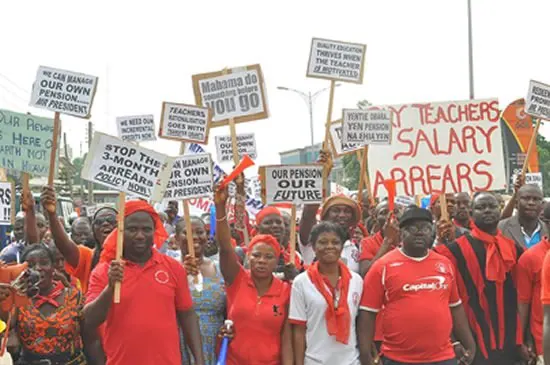
Ghana's Council of State has taken an active role in mediating the ongoing teachers' strike, which has now entered its third week. The strike, led by the National Association of Graduate Teachers (NAGRAT), the Ghana National Association of Teachers (GNAT), and the Pre-Tertiary Teachers Association of Ghana (PRETAG), has resulted in empty classrooms nationwide. The Council's Secretariat hosted representatives of the teacher unions on Friday, 9 October 2026, to discuss their grievances. The meeting was an effort to address the impasse ahead of the West African Senior School Certificate Examination (WASSCE).
The teacher unions' grievances center on several key issues, including delayed promotions, deprived-area allowances, and a stalled Collective Bargaining Agreement (CBA) with the Ministry of Education. The CBA, a negotiated contract between the employer and labor unions, sets out pay structures, benefits, and working conditions. Its delay has been a recurring sticking point in the unions' grievances. The Council of State's involvement marks an escalation in efforts to resolve the dispute. The meeting allowed union leaders to lay out their grievances before Council members.
The Controller and Accountant-General, Kwasi Agyei, reported that his department had processed the promotion records of 52,000 teachers as of 2:00 pm on Thursday, 8 October. This development paves the way for verification ahead of salary adjustments and payment of arrears. Agyei's update suggests some movement on the payments side, but no comprehensive timeline for resolving the deprived-area allowances or finalizing the CBA has been provided. The processing of promotion records follows a 28 September directive from Education Minister Haruna Iddrisu.
The strike has disrupted academic activity nationwide, affecting final-year secondary students preparing for the WASSCE. Abuakwa South MP Kingsley Agyemang previously warned that the standoff risked colliding directly with WASSCE preparations. The disruption has already produced visible consequences, including the use of a school compound in Kintampo as a cattle shelter. Residents have raised sanitation and health concerns over the unsupervised use of the premises.
For parents and students, the prolonged closure means lost instructional time just as WASSCE approaches. This raises questions about how much syllabus coverage and exam preparation schools will be able to complete before the exam window. The strike has significant implications for the education sector, with students and parents bearing the brunt of the disruption.
The involvement of the Council of State in mediating the strike is an unusual step, highlighting the gravity of the situation. The Council's Economic and Social Development Committee, led by HRM Drolor Rosso Adamtey I, is involved in the negotiations. While sources do not indicate what was agreed at Friday's meeting, the Council's involvement is seen as a positive step towards resolving the dispute.
The outcome of the Council of State's mediation efforts and the fate of the strike remain uncertain. No date has been given for when the strike might end or when outstanding teacher payments will be fully settled. The teacher unions and the government will need to work together to find a lasting solution to the dispute.
Key points
- The Council of State's involvement marks an escalation in efforts to resolve the dispute.
- The strike has disrupted academic activity nationwide, affecting final-year secondary students preparing for the WASSCE.
- The teacher unions' grievances center on delayed promotions, deprived-area allowances, and a stalled Collective Bargaining Agreement (CBA) with the Ministry of Education.