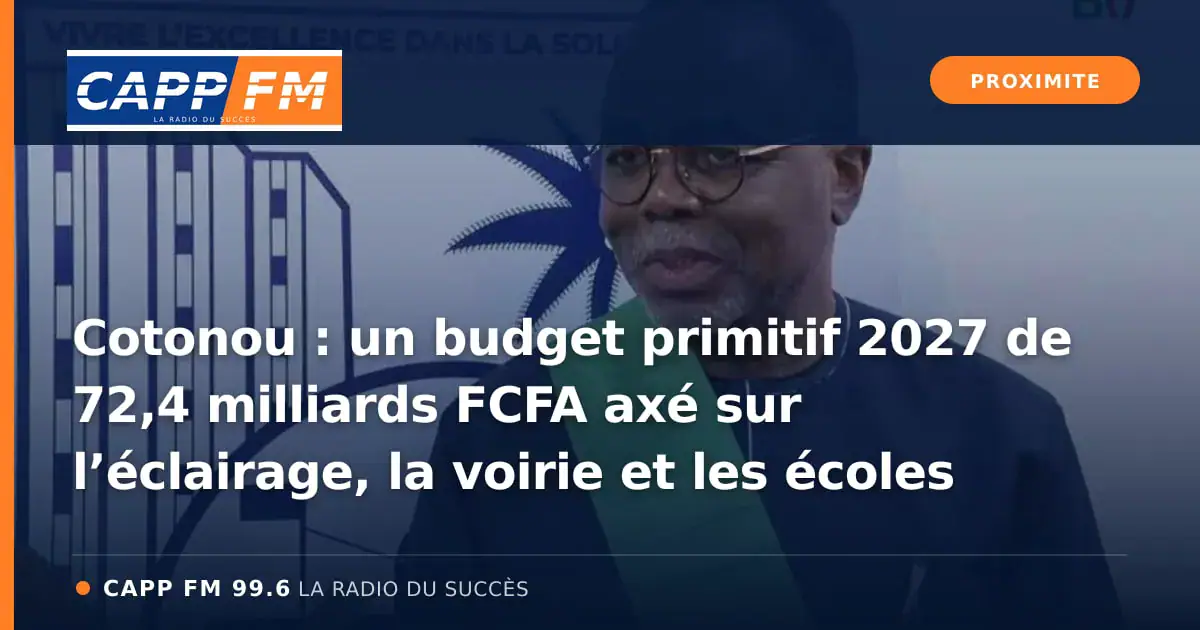
The commune of Cotonou in Benin has approved a 2027 budget of 72.4 billion FCFA, with over 74% allocated for investments. According to Mayor Luc Gnacadja, the primary priorities include solar lighting, road infrastructure, and school facilities. The budget was adopted unanimously by the Communal Council and reflects the community's needs, which were gathered through consultations in the city's 13 districts.
A significant portion of the budget, 1 billion FCFA, is dedicated to solar lighting, while over 1.2 billion FCFA will be spent on road infrastructure. These allocations are a direct response to the concerns expressed by residents during the consultations. The mayor emphasized that the choices were made based on the priorities identified by each district, with a focus on improving public lighting, road conditions, and school infrastructure.
The education sector will see significant investments, including the construction of new classrooms, completion of stalled projects, and the construction of school fences and toilets. Additionally, preparatory studies will be conducted for major projects planned for 2028 and 2029, including the construction of collectors, roads, and health centers. The municipality aims to initiate at least one visible project in each district in 2027.
Mayor Luc Gnacadja announced that the budget reflects a shift towards investments, which have increased by 47.54%, while operational expenses have decreased by 6.44%. He also emphasized that loans will be used for construction purposes, not for financing the commune's operations. Furthermore, the municipality plans to mobilize its own resources, following an audit of non-tax revenues.
The audit, conducted by the General Inspection of Finance, made 48 recommendations to improve the mobilization, tracking, and collection of municipal revenues. Mayor Gnacadja pledged to implement these recommendations rigorously to enhance the commune's financial management. He also promised to provide quarterly updates on the progress of projects, district by district.
The 2027 budget is considered the first budget of the 2026-2033 term and is subject to validation by the prefectural authorities before its implementation. Mayor Gnacadja also intends to raise concerns related to state competencies, such as the construction of police stations and certain health centers, with the government. The budget's focus on infrastructure development is expected to have a positive impact on the daily lives of Cotonou's residents.
The implementation of the budget will require careful planning and management to ensure that all projects are completed within the allocated timeframe and budget. The commune's residents will be closely monitoring the progress of these projects, and the municipality's ability to deliver on its promises will be crucial in maintaining trust and confidence in the local government.
Key points
- The 2027 budget of Cotonou is focused on infrastructure development, with a significant allocation for solar lighting, road infrastructure, and school facilities.
- The budget reflects a shift towards investments, with a 47.54% increase, while operational expenses have decreased by 6.44%.
- The municipality plans to mobilize its own resources and implement recommendations from an audit of non-tax revenues to improve financial management.