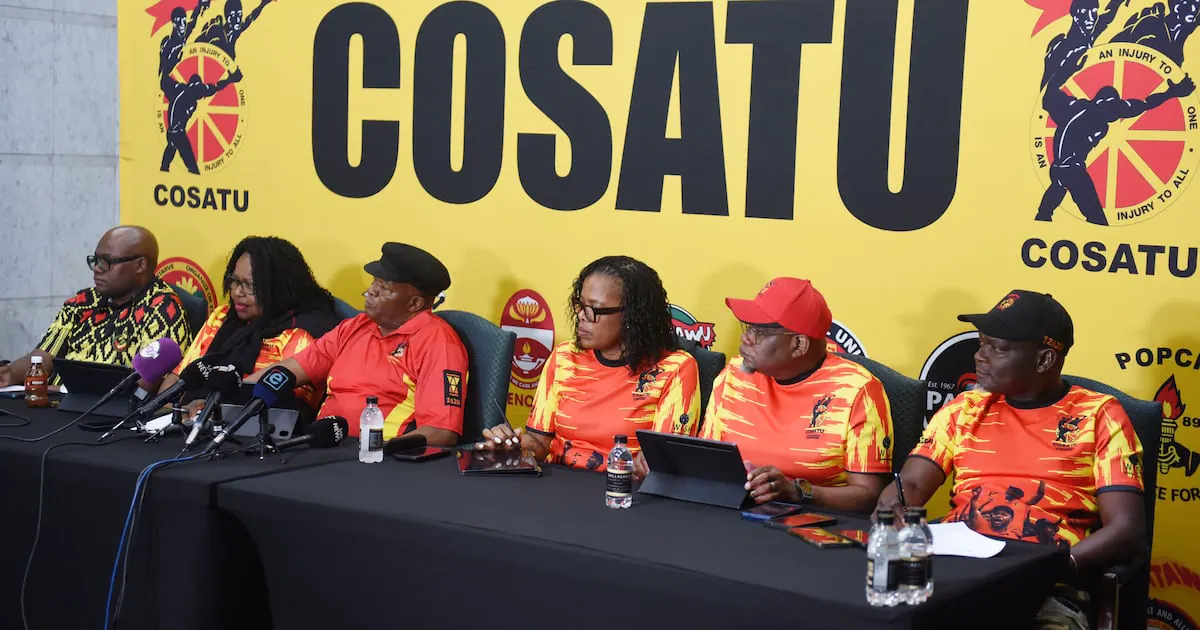
A concerning trend has emerged in South Africa's political discourse, where workers are judged on their class character based on the party they support. This approach is seen as analytically weak and organisationally dangerous, as it confuses electoral behaviour with class location and turns disagreement into disloyalty. The Congress of South African Trade Unions (Cosatu) was founded in 1985 on principles of non-racialism, worker control, and trade union democracy.
Cosatu's founding principles were designed to unite workers across party, workplace, sector, region, and ideological differences. The federation's organising slogan, "one union, one industry; one country, one federation", aimed to promote unity, not ideological sameness. However, contemporary attempts to define the "real" worker by party preference threaten to undermine this unity. These attempts do not sharpen class politics but rather impoverish it by shifting the focus from material conditions to political belonging.
The labour movement has always comprised workers with different political persuasions, united by their common condition of dependence on wages and exposure to exploitation. Cosatu's constitution commits the federation to a unified, democratic South Africa free from oppression and economic exploitation. The constitution speaks of a united working class, not a politically identical one, and not one belonging to a single party.
The suggestion that workers reveal their class character through their party support is seen as a betrayal of Cosatu's organisational wisdom. This approach reproduces division through ideological tests, which could weaken collective bargaining, fracture workplace unity, and gift employers with divided workers. A trade union federation must be broad enough to organise every worker who is exploited, underpaid, or denied a voice at work.
Class is not defined by a ballot paper or party card, but by a person's relationship to production, ownership, and labour. Workers remain workers regardless of their electoral choices, and their location in the economy does not change with each election cycle. Cosatu has the right to take political positions, but it must not use ideology as a stick to police workers' political choices.
Political education is a vital tradition in the labour movement, helping workers understand power, exploitation, and the economy. However, it must persuade, not police. Serious political education connects lived experience to the economy, the state, and public policy, without demanding party loyalty. Union leaders must resist the temptation to use ideology to dictate workers' political choices.
The South African labour movement has a broad tradition, shaped by diverse social forces and struggles. Its strength lies in its ability to unite workers around a common struggle against apartheid, exploitation, and oppression. Ultimately, Cosatu's task is to build disciplined, democratic, and class-conscious organisations that can bargain, mobilise, and shape public policy, without shrinking the working class into a sect.
Key points
- Cosatu must resist attempts to define workers by their party loyalty.
- The labour movement has always comprised workers with different political persuasions.
- Class is not defined by a ballot paper or party card.