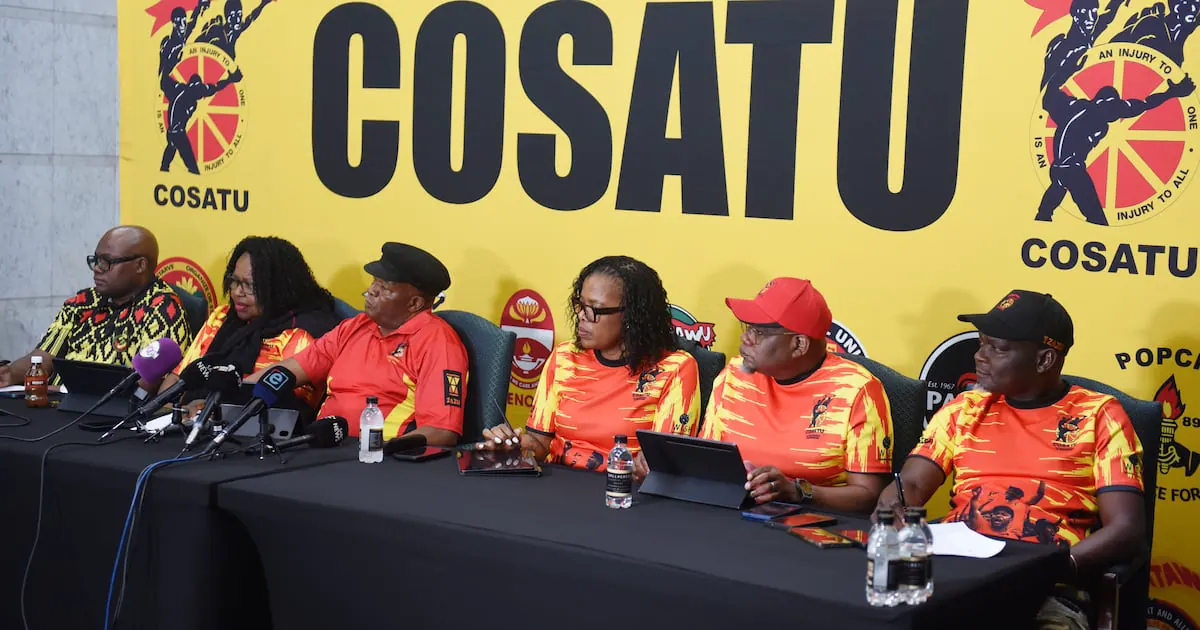
The Congress of South African Trade Unions (Cosatu) 4-day congress, which had cost approximately R12m to convene, collapsed on its second day due to an internal leadership struggle. The gathering, attended by delegates from across 16 Cosatu affiliates and invited guests, was marred by disagreements over the eligibility of a key presidential candidate, Mike Shingange. Shingange was suspended by his home union, the National Education Health & Allied Workers Union (Nehawu), just two days prior to the congress.
The dispute centered on Shingange's nomination for the presidency, opposed by Nehawu and its allies. The National Union of Mineworkers (NUM) and several other unions had nominated Shingange to take over from incumbent Zingiswa Losi as Cosatu president. However, Nehawu's suspension of Shingange led to allegations that the union was attempting to block his candidacy. The NUM and its allied unions refused to submit their official list of delegates, citing the suspension as a reason.
The congress was split, with Nehawu, the South African Democratic Teachers Union (Sadtu), Popcru, and a few other unions arguing that the congress should continue. Meanwhile, the NUM and its allies insisted that the congress be postponed due to the failure to adopt credentials within the required three hours. The deadlock led to a heated debate, with delegates expressing concerns about the implications of the collapse on the 1.8-million workers represented by Cosatu.
Despite efforts to find a solution, including a marathon meeting of Cosatu's central executive committee (CEC), the congress ultimately collapsed. Cosatu leaders confirmed the collapse, announcing that the congress would be reconvened within 30 days, as per the federation's constitution. The leadership struggle has significant implications for the ANC-led tripartite alliance.
The affiliates had arrived at the congress split between two leadership slates. The major public sector unions Nehawu, Sadtu, and Popcru, along with the South African Clothing & Textile Workers Union, backed Losi as the new general secretary, with Sadtu's Mabutho Cele replacing her as president. In contrast, the NUM led a group of seven unions, including the Democratic Nursing Organisation of South Africa, the finance union Sasbo, and the South African Municipal Workers Union, which wanted Shingange as the new president.
The collapse of the congress has raised concerns about the future of Cosatu, a 41-year-old labour grouping that represents some of South Africa's most vulnerable workers. The labour federation plays a critical role in advocating for workers' rights and influencing policy decisions. The leadership struggle has also sparked debate about the role of the South African Communist Party (SACP) in Cosatu.
The Cosatu congress collapse highlights the deep-seated divisions within the labour federation and the challenges it faces in navigating the complexities of South Africa's labour landscape. The reconvened congress will likely face significant challenges in addressing the concerns of its affiliates and the workers they represent. The outcome will have far-reaching implications for the future of Cosatu and its role in shaping South Africa's socio-economic and political landscape.
Key points
- Cosatu's congress collapsed due to a leadership struggle between two factions, one backing Zingiswa Losi and the other Mike Shingange.
- The collapse has significant implications for the ANC-led tripartite alliance and the future of Cosatu.
- The labour federation represents 1.8-million workers and plays a critical role in advocating for workers' rights and influencing policy decisions.