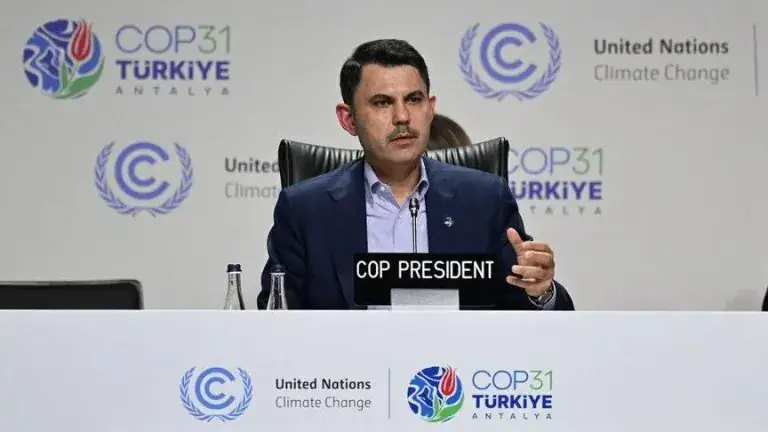
The 31st United Nations Climate Conference, COP31, concluded in Antalya, Turkey, on November 22, 2026, without a global agreement on climate change. Despite nearly 44 hours of extended negotiations, participants failed to reach a consensus. Australian co-president Chris Bowen expressed deep disappointment, stating that an agreement on the final decision could not be reached. The talks were marked by disagreements over the role of fossil fuels in the final text.
The last compromise draft, prepared by the Turkish and Australian presidencies, did not explicitly mention fossil fuels, despite calls from several delegations to clearly outline their role in the energy transition. However, the text did include a call for electrification. This omission drew opposition from the European Union, Panama, Switzerland, and the Marshall Islands. Irish Climate Minister Darragh O'Brien, representing the EU, deemed it unacceptable to adopt a text without referencing fossil fuels.
O'Brien stated that the proposed decisions fell short of the ambition needed to combat climate change. Turkish COP31 President Murat Kurum acknowledged the lack of consensus and announced that the proposed decisions would not be adopted. He expressed regret, noting that several parties had opposed the text. In contrast, Saudi Arabia, speaking on behalf of the Arab group, supported the compromise, saying it contained measures to promote climate action.
The Chinese delegation called for a spirit of compromise while expressing concerns. The representative of Ghana, speaking for the African group, criticized the lack of progress on climate action financing and regretted the conditions under which her speech was interrupted. However, she indicated that African countries were willing to allow the adoption of the text in the name of multilateralism.
UN Secretary-General Antonio Guterres expressed profound disappointment at the lack of consensus, sharing the frustration of those who had hoped for a stronger response to the climate crisis. The COP31 in Antalya surpassed the previous record for duration, set by COP25 in Madrid in 2019, with nearly 44 hours of extended negotiations.
The outcome of COP31 has been met with mixed reactions. Some countries, like the European Union, had pushed for a stronger agreement, while others, like Saudi Arabia, had supported the compromise. The lack of agreement on fossil fuels has raised concerns about the effectiveness of the climate talks in addressing the crisis.
The failure to reach an agreement at COP31 highlights the ongoing challenges in international climate negotiations. The conference's outcome has significant implications for global efforts to address climate change, and the lack of consensus on fossil fuels will likely continue to be a point of contention in future talks.
Key points
- The COP31 conference in Antalya failed to reach a global agreement on climate change due to disagreements over the role of fossil fuels.
- The lack of consensus on fossil fuels drew opposition from several countries, including the European Union and the Marshall Islands.
- The conference's outcome has significant implications for global efforts to address climate change.
Reporting sources
- Côte d’Ivoire-AIP/Inter/ COP31: les négociations s’achèvent à Antalya sans accord global sur le climat · Agence ivoirienne de presse