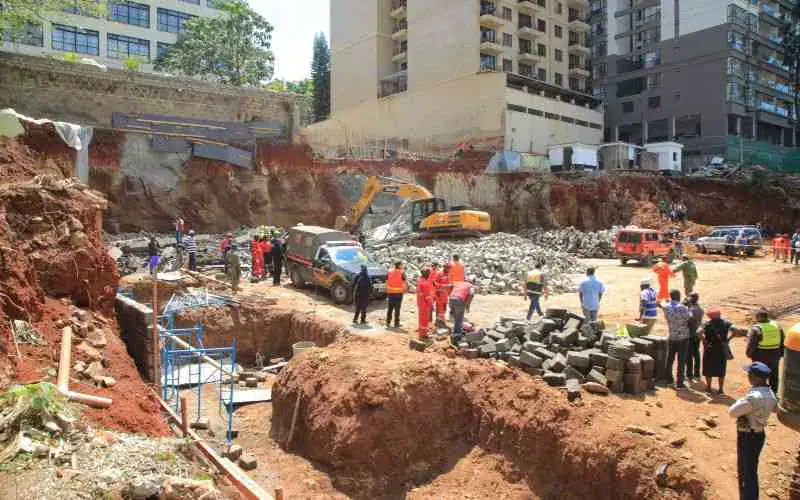
A building under construction collapsed along Mombasa Road in Kenya, killing six people and injuring several others. The incident occurred at around 8am, with witnesses reporting that it was raining at the time of the collapse. Rescue teams took about an hour to arrive at the scene, highlighting concerns over emergency response times. The collapse is the latest in a series of similar incidents in Kenya, raising questions over safety and accountability in the construction sector.
The incident is particularly disturbing given that it occurred barely a month after a similar building collapse in Eastleigh, Nairobi. In that incident, several people were killed and injured. The repeated collapses have raised serious questions over the enforcement of safety regulations and the accountability of developers and contractors. According to Nairobi City County Fire and Rescue Commander Bramwel Simiyu, preliminary reports indicated that the top slab had collapsed while workers were on site.
The Kenyan government has laws, building standards, and institutions charged with regulating construction, but repeated collapses suggest that enforcement and coordination are lacking. Approvals on paper mean little if inspections are irregular, violations ignored, or officials look away. Developers and contractors who cut corners must face consequences, as must regulators who fail in their duties. The National Construction Authority and other agencies must inspect projects throughout construction, not merely at approval or after tragedy strikes.
County governments, the National Construction Authority, and other agencies must stop operating as disconnected offices. They should inspect projects throughout construction, not merely at approval or after tragedy strikes. Work on unsafe sites must be halted, and structural designs and inspection reports opened to scrutiny. Safety rules must apply equally to influential developers and small contractors. Workers must be able to report unsafe conditions without fear of losing their jobs.
The construction sector in Kenya has experienced rapid growth in recent years, but this growth must be accompanied by a commitment to safety and accountability. Protective equipment, safe working procedures, and emergency plans are not optional costs; they are basic obligations. Neighbouring traders and residents also deserve protection from poorly secured sites. The six lives lost on Mombasa Road and the four in Kileleshwa must not become another statistic followed by silence.
A credible investigation, public findings, prosecutions where warranted, and stronger inspections are the minimum response to the recent construction collapses. Kenya cannot keep celebrating a construction boom while burying its victims. Development is measured not by how quickly buildings rise, but by whether people can build, work, and live around them safely. The government must take concrete steps to address the concerns over safety and accountability in the construction sector.
The Standard Group Plc, a leading multi-media house in Kenya, has called for greater accountability in the construction sector. In an editorial, the company stated that the repeated collapses are an indictment of a construction sector in which safety checks and the protection of workers and the public too often come second to the rush to build. The company has emphasized the need for a thorough, independent investigation into the causes of the collapses and for developers and contractors to face consequences for cutting corners.
Key points
- The construction sector in Kenya must prioritize safety and accountability to prevent further tragedies.
- The government must take concrete steps to address concerns over safety and accountability in the construction sector.
- A credible investigation and public findings are necessary to determine the causes of the recent construction collapses.
Reporting sources
- Construction must be accompanied by accountability · The Standard