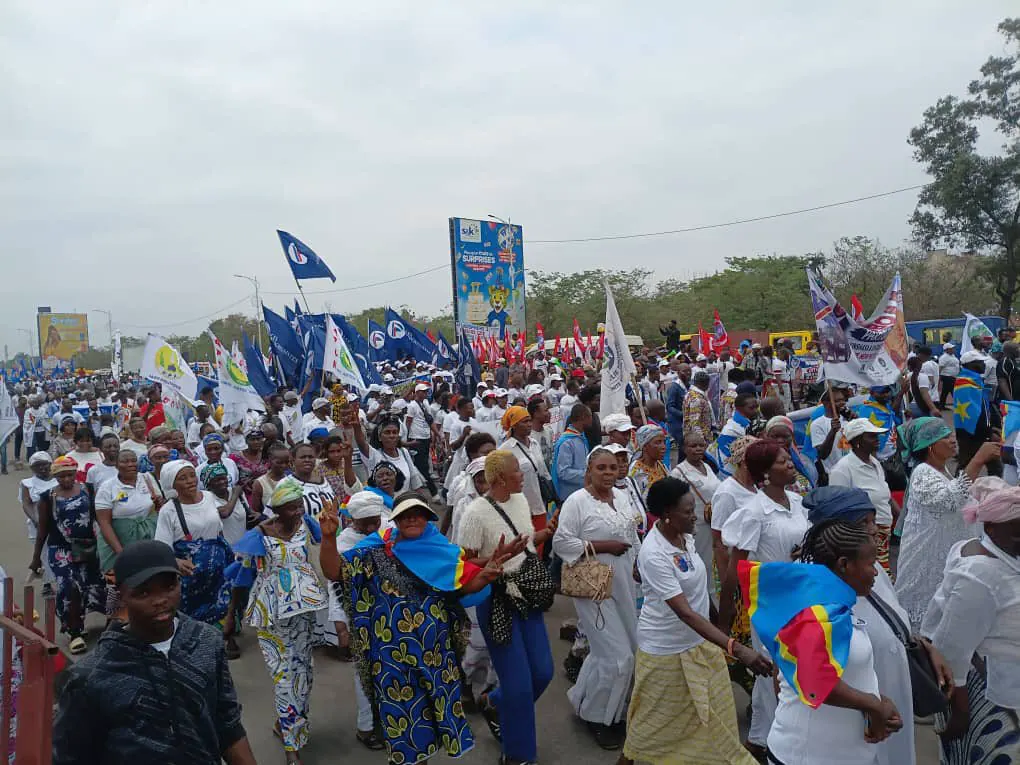
The Congolese press has been analyzing the recent political marches that took place across the country, particularly the one organized by the ruling party, Union for Democracy and Social Progress (UDPS). According to Le Phare, the large turnout at the UDPS march on Tuesday demonstrates that the people support the institutions. The newspaper questions the legitimacy of the majority or opposition to speak on behalf of the people, noting that the term "people" has become a generic term used by all.
However, not all newspapers share the same view. Congo Nouveau, a tri-weekly newspaper, describes the UDPS march as "a mobilization in trompe-l'oeil" (a French idiom meaning "a mobilization that is not what it seems"). While acknowledging a colorful procession in Kinshasa, the newspaper believes that the event was marred by internal fractures and erosion of militant capital. It also notes that the march was cancelled in Kisangani due to the Ebola epidemic, and there was low attendance in Kikwit and Kindu.
The absence of key figures from the Union Sacrée, such as Vital Kamerhe's UNC, Jean-Pierre Bemba's MLC, and Modeste Bahati's AFDC-A, was also noted by Congo Nouveau. According to the newspaper, this absence reduced the event to a simple partisan rally rather than a demonstration of force by the entire majority. This selective mobilization has sparked debate about the state of democracy in the country.
Le Nouvel Observateur has also weighed in on the issue, highlighting the contrast in the treatment of public freedoms. The newspaper recalls that, unlike the Coalition 64 (C64) march on September 15, which was marked by serious violence, the UDPS march took place under benevolent police supervision. It questions whether the country is moving at two speeds and wonders where democracy is.
Meanwhile, the C64 platform has denounced what it calls a "selective application of the ban on demonstrations" by urban authorities, from its base in Haut-Katanga. This selective enforcement has led to concerns about the fairness and impartiality of the government's actions. The C64 platform's criticism adds to the ongoing debate about the state of democracy and public freedoms in the country.
The repercussions of the marches have also been felt in the provinces. According to Le Potentiel.cd, the New Congolese Civil Society (NSCC) has denounced the paralysis of socio-economic activities caused by the partisan march in Mwene-Ditu (Lomami). This paralysis has had a negative impact on the local economy and daily life.
Finally, La Prospérité reports that the National Human Rights Commission, led by Paul Nsapu, is continuing its consultations with various stakeholders. During these consultations, the National Intersyndicale of Public Administration (INAP) recalled that the preservation of public freedoms and fundamental rights must fully integrate the defense of workers' rights. The Commission's efforts aim to promote and protect human rights in the country.
Key points
- The UDPS march was marked by a large turnout in Kinshasa, but was criticized for low attendance in other areas and the absence of key figures from the Union Sacrée.