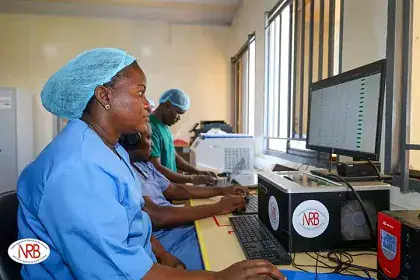
The National Biomedical Research Institute (INRB) in the Democratic Republic of Congo has made significant progress in sequencing Ebola virus genomes. According to a communiqué from the institution, they have successfully sequenced 1,526 complete genomes of the Bundibugyo virus in less than six months. This achievement is part of the ongoing surveillance of the Ebola virus disease (EVD) in the country. The INRB's efforts are being carried out under the supervision of professors Tony Wawina B. and Placide Mbala K.
To put this achievement into perspective, during the 2013-2016 Ebola outbreak in West Africa, a total of 1,610 Ebola virus genomes were sequenced over a period of nearly 20 months. The INRB's recent accomplishment demonstrates a significant improvement in the speed and efficiency of genomic sequencing. This progress is crucial in enhancing the understanding of the epidemic and informing response efforts against the Bundibugyo virus disease.
The INRB's achievement is considered an important milestone in genomic surveillance. By producing a large number of genomic sequences, the institute is contributing to a better understanding of the virus and its evolution. This information can be used to improve diagnostic tools, develop effective treatments, and inform public health strategies. The INRB plans to continue its efforts, with the goal of reaching 2,500 genomic sequences of the Bundibugyo virus.
The ongoing Ebola outbreak in the Democratic Republic of Congo has presented significant challenges to public health authorities. The disease has affected multiple regions, including the city of Butembo, where there has been a reported decline in the number of confirmed cases per day. The INRB's work is critical in supporting the response efforts and helping to bring the outbreak under control.
The INRB's achievement is a testament to the institution's capacity and commitment to addressing public health challenges. The institute's work is being carried out in collaboration with other stakeholders, including the Congolese government and international partners. The goal of reaching 2,500 genomic sequences is ambitious, but it reflects the INRB's determination to contribute to the global response to the Ebola outbreak.
The Democratic Republic of Congo has been affected by multiple Ebola outbreaks in recent years. The country has made significant progress in responding to these outbreaks, including the development of effective surveillance systems and response strategies. The INRB's work is an important part of this effort, and its achievements have the potential to inform public health strategies not only in Congo but also in other countries affected by the disease.
The INRB's sequencing efforts are ongoing, and the institute is committed to producing high-quality genomic data. The data generated by the INRB will be used to inform public health strategies and to support the development of effective treatments and diagnostic tools. By continuing to sequence Ebola virus genomes, the INRB is contributing to the global response to the disease and helping to protect public health.
Key points
- The INRB has sequenced 1,526 Ebola virus genomes in under six months, a significant improvement in speed and efficiency compared to previous outbreaks.
Reporting sources
- Ebola en RDC: l’INRB réalise un séquençage de 1 526 génomes du virus Bundibugyo · Congolese press agency