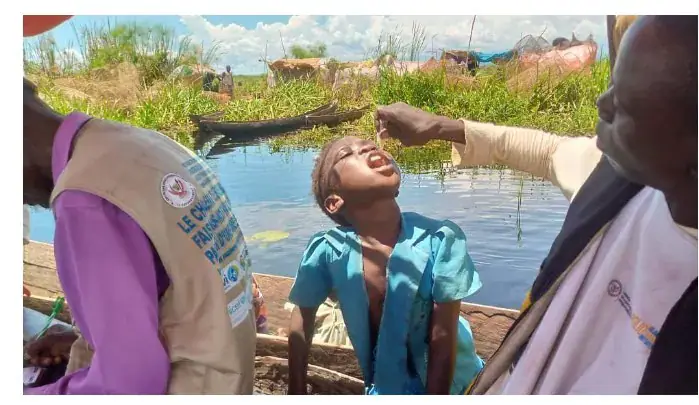
The Democratic Republic of Congo and Congo-Brazzaville have launched a joint vaccination campaign against cholera, targeting two million people in the western part of the country. The campaign, which ran from November 3 to 10, 2026, aims to curb the resurgence of the epidemic. According to the World Health Organization, the DRC reported around 60,000 cholera cases by the end of October. The campaign focuses on populations living on scattered islands along the Congo River.
The vaccination campaign is a coordinated effort between the two countries, with operations taking place on both banks of the Congo River to limit the trans-border spread of the disease. Health teams are using pirogues, motorized boats, and local community relays to reach populations in isolated camps. Professor Didier Bompangué, the WHO's cholera expert in the DRC, emphasized the importance of cooperation between Kinshasa and Brazzaville, stating that vaccination limited to one bank would not be enough to stop the transmission of the disease.
The campaign began on November 3 in the Equateur province and will continue in Mai-Ndombe from November 10, before reaching Kinshasa on November 24, in coordination with Congo-Brazzaville authorities. The WHO reported that the start of the rainy season, marked by heavy rainfall and rising waters, has complicated access to targeted camps. Initially, vaccination activities were supposed to start during the dry season.
The vaccination campaign aims to immunize people in areas most affected by the cholera outbreak. Health teams face challenges in accessing isolated communities, but the use of boats and community relays has helped to overcome these difficulties. The cooperation between the DRC and Congo-Brazzaville is seen as crucial in controlling the spread of the disease.
According to the WHO, the cholera epidemic in the DRC has been exacerbated by the rainy season. The organization has been working closely with the Congolese authorities to respond to the outbreak. The vaccination campaign is part of a broader effort to control the spread of cholera in the region.
The challenges posed by the rainy season have been significant, with health teams struggling to access some areas. Despite these challenges, the vaccination campaign has made progress, and health authorities are optimistic about its impact. The campaign's success will depend on continued cooperation between the DRC and Congo-Brazzaville.
The joint vaccination campaign is a significant step towards controlling the cholera outbreak in the DRC and Congo-Brazzaville. The WHO and other health organizations are providing support to the Congolese authorities to ensure the campaign's success. Three key points have emerged from the campaign so far: the importance of cooperation between countries, the challenges posed by the rainy season, and the need for sustained efforts to control the spread of cholera.
Key points
- The vaccination campaign targets two million people in the western part of the Democratic Republic of Congo.
- The campaign is a joint effort between the DRC and Congo-Brazzaville to control the spread of cholera.
- The rainy season has posed significant challenges to the vaccination campaign, but health teams are working to overcome these difficulties.
Reporting sources
- RDC : une campagne de vaccination contre le choléra vise deux millions de personnes · Gabon Press Agency