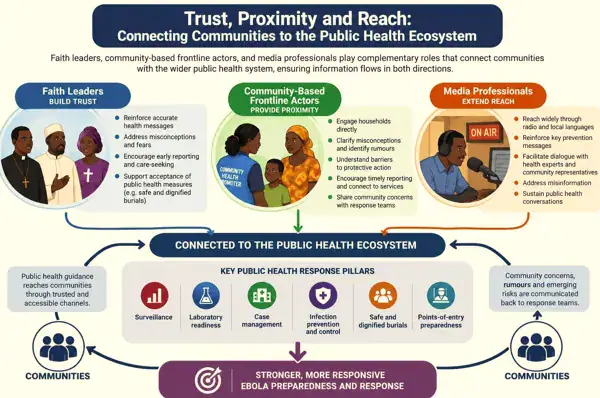
As Ebola preparedness and response efforts gain momentum in South Sudan and Africa, experts emphasize that community involvement is crucial. Effective preparedness relies not only on strong surveillance systems, laboratory capacity, and health system readiness but also on communities' ability to recognize risks, trust public health guidance, report suspected cases, and participate in prevention and response efforts.
South Sudan's Ebola preparedness efforts are critical given the regional public health situation, particularly in the neighboring Democratic Republic of the Congo (DRC) and reported cases in Kenya. As of October 25, 2026, the DRC had recorded 10,060 confirmed cases and 4,887 deaths, while Kenya had reported nine confirmed cases and two deaths as of October 26. These developments highlight the importance of vigilance, especially in South Sudan's border communities.
The United Nations Office for the Coordination of Humanitarian Affairs (OCHA) reports that over 5,000 people crossed into South Sudan from the DRC between July and mid-October, entering through Ibba County in Western Equatoria State. Many of these individuals had urgent humanitarian needs, underscoring the intersection of population movements, humanitarian vulnerability, and public health preparedness.
South Sudan has strengthened its Ebola preparedness architecture through the Ministry of Health, the National Public Health Institute, and partners. Efforts include surveillance, laboratory readiness, infection prevention and control, points-of-entry preparedness, and simulation exercises in Juba, Yei, and Yambio. A national toll-free alert line, 6666, provides a mechanism for reporting suspected cases.
Despite these investments, even the most technically prepared health system remains vulnerable if the communities it serves are not equally prepared. A surveillance system may be ready to investigate a suspected case, but someone must first recognize and report it. Community engagement is essential to translate health information into practical action, address misinformation, and strengthen trust.
Faith leaders, community-based frontline actors, and media professionals play critical roles in South Sudan's ecosystem. They provide three critical dimensions of effective Risk Communication and Community Engagement (RCCE): trust, proximity, and reach. Faith leaders can serve as trusted intermediaries between communities and public health authorities, reinforcing accurate prevention messages and addressing misconceptions.
Community-based frontline actors, such as Community Health Promoters and Boma Health Workers, provide proximity and interpersonal engagement to translate public health information into practical action. They can clarify misconceptions, provide guidance on early reporting and care-seeking, and promote understanding of public health measures. Effective RCCE requires building relationships with trusted community structures and establishing mechanisms for community participation in preparedness and response.
Key points
- Community involvement is crucial for effective Ebola preparedness and response in South Sudan.
- Faith leaders, community-based frontline actors, and media professionals play critical roles in building trust, proximity, and reach in RCCE efforts.
- RCCE is essential to translate health information into practical action, address misinformation, and strengthen trust in communities.