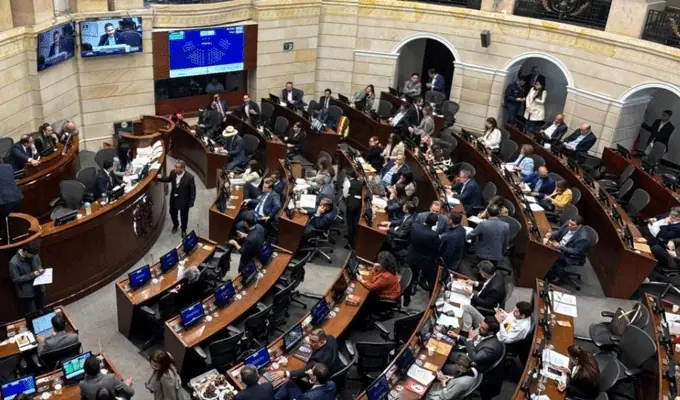
The Colombian Congress has approved a reform that marks a significant shift in the country's security policy. The new legislation, supported by President Abelardo De La Espriella, requires armed groups to submit to justice and fulfill strict obligations to be eligible for reduced sentences. This move reverses the previous "total peace" policy of former President Gustavo Petro, which focused on negotiations with armed groups. The reform was approved by the Senate with 57 votes against 24 and by the House of Representatives with 95 votes against 10.
Under the new legislation, members of armed organizations will no longer have access to public office or be able to negotiate political agreements in exchange for their surrender. To be eligible for favorable treatment, combatants must disarm, surrender their assets, identify their networks, and reveal their political links or corruption circuits. They must also contribute to the liberation of recruited or kidnapped minors and the search for missing persons. The reform provides for reduced sentences of up to 50% for certain members and 30% for commanders, but leaders must serve at least 10 years in prison.
The Colombian government justifies this change by citing the insufficient results of the previous policy. According to the Ministry of Defense, the number of members of illegal armed groups has increased from 15,120 in late 2022 to approximately 28,802 in July 2026. The administration of President De La Espriella believes that previous negotiations have favored the expansion of these organizations, particularly in territories linked to narcotics trafficking and illegal mining.
The conflict in Colombia has its roots in the confrontations between liberals and conservatives in the 1940s, known as La Violencia. The concentration of land, rural poverty, and political exclusion have contributed to the emergence of Marxist guerrillas, such as the Revolutionary Armed Forces of Colombia (FARC) and the National Liberation Army (ELN). Over time, ideological motivations have mixed with economic interests, including narcotics trafficking, kidnapping, extortion, and illegal mining.
The 2016 peace agreement between the government and the FARC led to the demobilization of a large part of the guerrilla group. However, other organizations have continued their activities, and dissident groups have refused the peace process. The persistence of rural inequalities, weak state presence in certain regions, and the income from illegal economies have limited the prospects for pacification.
The new strategy adopted by the Colombian government relies on a change of approach, offering reduced sentences in exchange for disarmament, asset restitution, and judicial cooperation, while maintaining military pressure. The success of this approach depends on the ability of the state to secure territories, protect populations, and reduce the economic resources of armed groups.
The Colombian economy is one of the main economies in Latin America, with a GDP of $457.4 billion in 2025. The country faces significant challenges, including social and territorial inequalities, poverty, economic informality, public finances, and insecurity in certain regions. The implementation of the new security policy and its impact on the economy and society remain to be seen.
Key points
- The Colombian Congress has approved a reform that imposes stricter conditions on armed groups to surrender, reversing the previous "total peace" policy.
- The new legislation requires armed groups to submit to justice and fulfill strict obligations to be eligible for reduced sentences.
- The success of the new strategy depends on the ability of the state to secure territories, protect populations, and reduce the economic resources of armed groups.