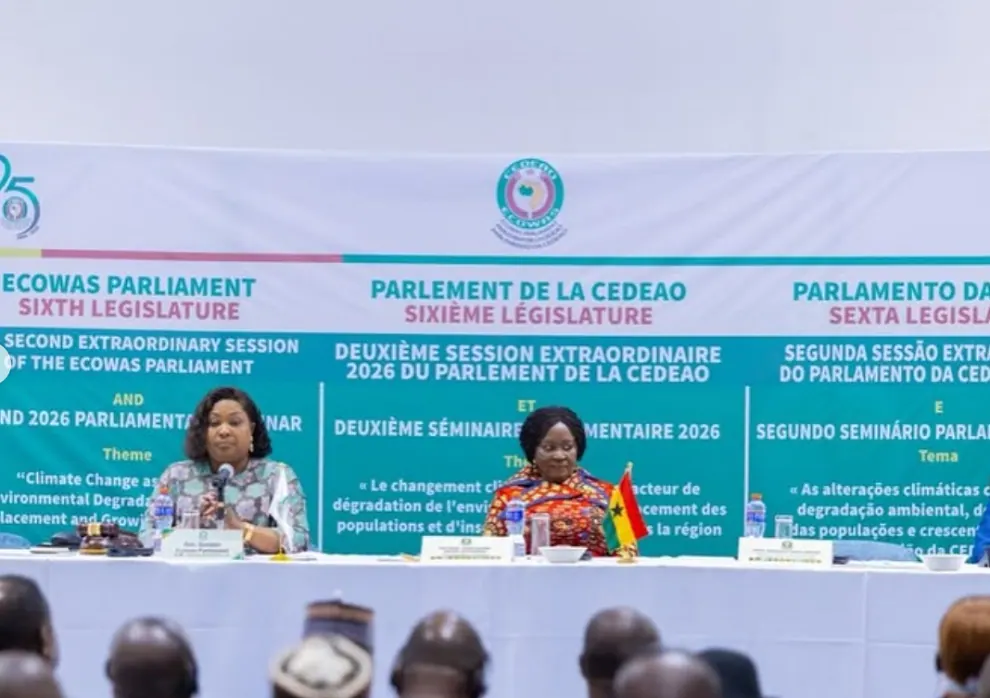
The Economic Community of West African States (ECOWAS) has expressed concern over the potential displacement of up to 32 million people in the region by 2050. This projection is attributed to climate change, environmental degradation, and rising insecurity, which are increasingly fueling displacement and threatening regional stability. The warning was delivered at the Second 2026 Parliamentary Seminar of the ECOWAS Parliament in Accra, Ghana.
Regional lawmakers gathered to examine the links between climate change, population displacement, and insecurity. Representing the President of the ECOWAS Commission, General Birame Diop, the Commissioner for Human Development and Social Affairs, Professor Nassirou Bako-Arifari, revealed that more than two million people were displaced in West Africa in 2024 due to climate-linked natural disasters. He added that over seven million people were affected by flooding during the same period.
The flooding destroyed homes, roads, schools, health facilities, and farmlands. According to the ECOWAS Commission’s presentation, the combined effects of climate change and other sources of insecurity resulted in more than 12 million internally displaced persons (IDPs) across West and Central Africa between 2025 and 2026. Women and children accounted for 80% of that figure, highlighting the disproportionate impact on vulnerable populations.
Professor Bako-Arifari emphasized that climate change is not simply an environmental issue, but a development issue, a humanitarian issue, a peace and security issue, and ultimately an issue of human survival and regional stability. Citing World Bank projections, he reiterated that internally displaced populations in the sub-region could reach nearly 32 million by 2050 if current trends continue.
To address this challenge, Professor Bako-Arifari urged ECOWAS member states to transition from fragmented responses to a comprehensive regional climate-resilience and human-security framework. He emphasized that the region must be proactive and invest in resilience before crises occur, protecting ecosystems, creating sustainable livelihoods, and addressing grievances before they escalate into open conflict.
The ECOWAS Commission also highlighted a major climate-financing gap, estimating that $294 billion is needed to satisfy regional climate action requirements. Since 2024, ECOWAS has been working to establish a regional carbon market platform under Article 6 of the Paris Agreement to help mobilize needed investments. The Commission called on parliamentarians to strengthen climate-responsive legislation and prioritize funding.
The seminar was held under the theme: “Climate Change as a Driver of Environmental Degradation, Population Displacement and Rising Insecurity in the ECOWAS Region.” The Commission urged governments to place women and young people at the center of resilience efforts, describing them as essential innovators, entrepreneurs, and community leaders. The Second 2026 Extraordinary Session of the ECOWAS Parliament will also consider the institution’s 2027 budget and activity program.
Key points
- Up to 32 million people in West Africa may be displaced by 2050 due to climate change.
- Climate change is not simply an environmental issue, but a development issue, a humanitarian issue, a peace and security issue.
- The ECOWAS Commission estimates that $294 billion is needed to satisfy regional climate action requirements.