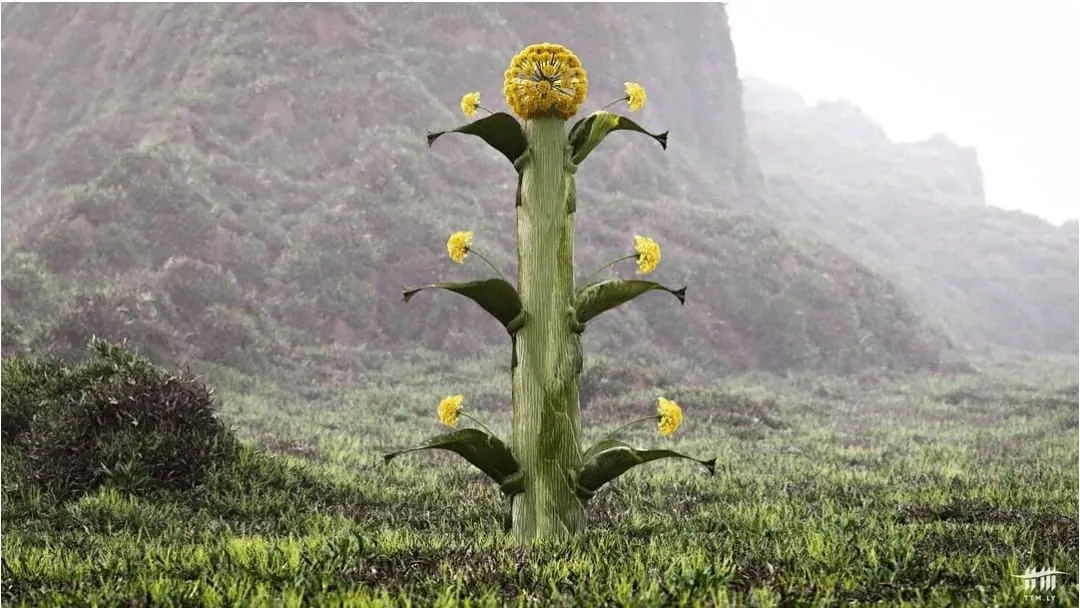
A Facebook post published on November 28, 2025, at 2:00 PM Libyan time, claimed that the Silphium plant had reappeared in eastern Libya after being declared extinct. The post garnered approximately 2.7 thousand interactions and 188 comments by December 15, 2025. However, a thorough investigation by World History, a reputable online encyclopedia, revealed that the Silphium plant, a symbol of the ancient economy of Cyrenaica, had indeed become extinct by the 1st century AD.
According to World History, the Silphium plant was a wild, uncultivated species that grew in Cyrenaica, and its disappearance was caused by over-exploitation and over-grazing, rather than soil degradation. The Cambridge Greek Lexicon confirms that Silphium was a plant that grew in Cyrenaica, but it is associated with Ferula, a type of plant. Modern scientific research suggests that Ferula drudeana, a rare plant discovered in three limited locations in Turkey's Anatolia region, is the closest relative of Silphium.
The reappearance of Silphium in Libya, claimed to have occurred in the city of Al-Marj, is likely due to visual confusion with similar-looking local plants belonging to the same botanical family, such as Drias and Kalakh. Dr. Tariq Awad al-Maqsabi, a professor of plant ecology at the University of Benghazi, stated on his official Facebook account that the claim of Silphium's reappearance is likely the result of visual confusion with local plants.
Experts stress that any new plant appearing in the region requires thorough genetic and chemical analysis to prove its identity, as visual similarity is not a reliable scientific indicator of a plant's identity. The historical record of Silphium's extinction and the lack of scientific evidence supporting its reappearance in Libya confirm that the claim is unfounded.
The investigation into the claim involved searching through historical records and consulting with experts in botany and ecology. The results confirm that Silphium has been extinct for centuries, and its reappearance in eastern Libya is highly unlikely. The claim has been widely shared on social media, highlighting the need for fact-checking and verification of information.
The Silphium plant was highly valued in ancient times for its unique properties and uses. Its extinction has been well-documented, and efforts to rediscover or reintroduce the plant have been ongoing. However, any claims of its reappearance must be thoroughly verified through scientific analysis to ensure accuracy.
In conclusion, the claim that Silphium has reappeared in eastern Libya is unfounded and likely the result of visual confusion with similar-looking local plants. Experts and historical records confirm that Silphium has been extinct for centuries, and its reappearance in the region is highly unlikely.
Key points
- The Silphium plant has been extinct since the 1st century AD due to over-exploitation and over-grazing.
- Ferula drudeana, a rare plant discovered in Turkey, is considered the closest relative of Silphium.
- Visual similarity is not a reliable indicator of a plant's identity, and thorough genetic and chemical analysis is required to confirm a plant's identity.