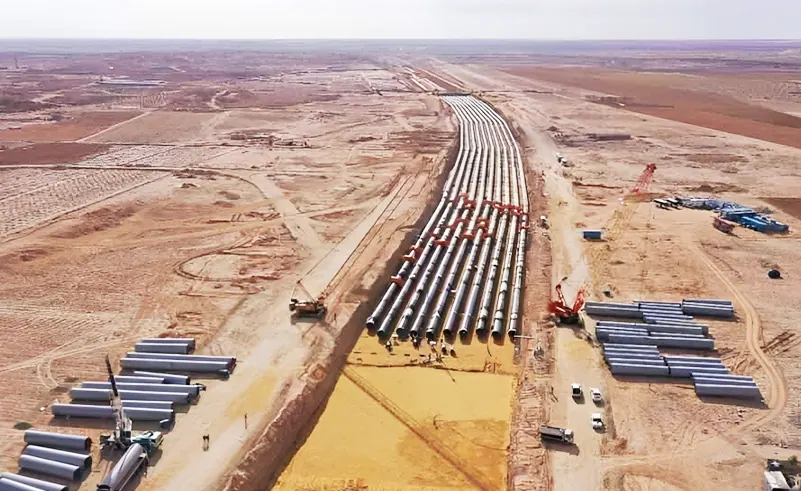
A Facebook post published on May 25, 2024, at 10:39 PM Libyan time, made a claim that Egypt has started building an artificial river to transport water from the Kufra Basin to Egyptian cities. The post suggested that this project aims to irrigate millions of hectares for major crop cultivation and vegetable production for export. The claim garnered around 389 interactions by May 27, 2024. Similar claims and images have been circulating widely since 2022.
Research by Annir revealed that the claim is misleading. The Nubian Sandstone Aquifer System, from which the water is allegedly being transferred, is a shared basin extending over 2.2 million square kilometers. This includes over 760,000 square kilometers in Libya, 828,000 square kilometers in Egypt, 376,000 square kilometers in Sudan, and 235,000 square kilometers in Chad. A joint authority was formed in 1989 between Libya and Egypt to study and develop this aquifer.
The Future of Egypt, a device responsible for the "Future of Egypt" project, stated on its official Facebook page that the project relies on groundwater and treated wastewater from the Hamam wastewater treatment plant. The region benefits from the renewable Western Delta aquifer and the Nubian Sandstone Aquifer System. This clarifies that the project utilizes local resources rather than transferring water from Libya.
In June 2023, the Egyptian news site Al-Masry Al-Youm reported on the launch of two massive projects in the New Delta, including the largest artificial river in the world and a waterway for irrigation of the "Future of Egypt" agricultural project. These projects aim to enhance Egypt's water resources and agricultural capabilities.
An agreement was signed in 1991 between Libya, Egypt, Chad, and Sudan to establish a joint authority for the development of the aquifer's waters. The agreement set standards for the distribution of water resources based on several criteria, including the percentage of the aquifer's area in each country, population, and water dependency. Egypt's share is 38%, while Libya's is 17%.
The Nubian Sandstone Aquifer System is a shared resource, and its management involves cooperation between the countries it spans. Therefore, the claim that Egypt is unilaterally transferring Libyan water through an artificial river is inaccurate. Egypt's projects, such as the "Future of Egypt," focus on utilizing local water resources sustainably.
Annir's investigation concluded that the claim is misleading, emphasizing the shared nature of the Nubian aquifer and the cooperative management among the involved countries. The "Future of Egypt" project and other initiatives aim to enhance water security and agricultural production using local and treated water sources.
Key points
- The Nubian Sandstone Aquifer System is a shared basin between Libya, Egypt, Sudan, and Chad, managed through a joint authority.
- Egypt's water projects, such as "Future of Egypt," rely on local groundwater and treated wastewater.
- The claim of Egypt building an artificial river to transfer Libyan water is misleading and lacks factual basis.