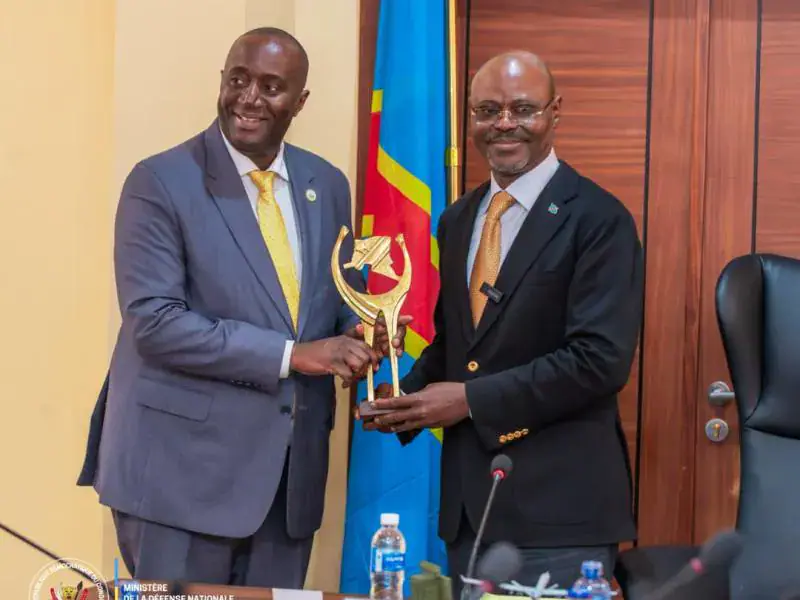
The Deputy Prime Minister of National Defense, Guy Kabombo, received a delegation from the International Conference on the Great Lakes Region (CIRGL) in Kinshasa on November 3. The delegation, led by CIRGL Executive Secretary Ambassador Mubita Luwabelwa, aimed to follow up on recommendations from recent meetings in Lusaka, Zambia. These meetings focused on standardizing operational procedures for disarming and reintegrating foreign armed groups.
The Lusaka meetings, which took place from October 14-16, involved several regional states and examined a project for standard operational procedures for disarming and reintegrating foreign armed group members. The goal was to enhance cooperation and coordination among regional countries to address common security challenges. The implementation of these mechanisms is expected to strengthen the regional response to foreign armed groups, including the FDLR, ADF, and RED-Tabara.
As Chair of the CIRGL Defense Ministers Committee, Guy Kabombo emphasized the need to make the Defense pillar more operational and ensure better follow-up during the Democratic Republic of Congo's presidency. He highlighted the importance of examining the level of implementation of recommendations and concrete arrangements for improving the preparation and follow-up of future Defense sector meetings.
Kabombo also stressed the significance of strengthening the Expanded Joint Verification Mechanism (MCVE and MCVE+), an instrument for verification, trust, and support for the peace process in the Great Lakes region. He encouraged further discussions between CIRGL Secretariat experts and Defense ministry experts to deepen the technical aspects of the dossiers addressed.
The meetings take place amid persistent tensions between regional states, with the Democratic Republic of Congo, Rwanda, and Burundi accusing each other of supporting armed groups for destabilization purposes. The ADF, an armed group affiliated with the Islamic State, continues to carry out deadly attacks against civilians in eastern Democratic Republic of Congo.
The Kinshasa meeting occurs in the context of the Democratic Republic of Congo's announcement of a protocol agreement on the disarmament, demobilization, and cantonment of the FDLR. However, this initiative has been contested by Rwanda, which sees it as an attempt to circumvent commitments under the Washington agreements.
The CIRGL meetings aim to consolidate cooperation and coordination among regional countries to address security challenges. The implementation of the agreed-upon mechanisms is expected to enhance the regional response to foreign armed groups and promote stability in the Great Lakes region.
Key points
- The CIRGL meeting in Kinshasa focuses on following up on Lusaka security recommendations.
- The Democratic Republic of Congo is committed to making the Defense pillar more operational.
- The region faces persistent security challenges from foreign armed groups.