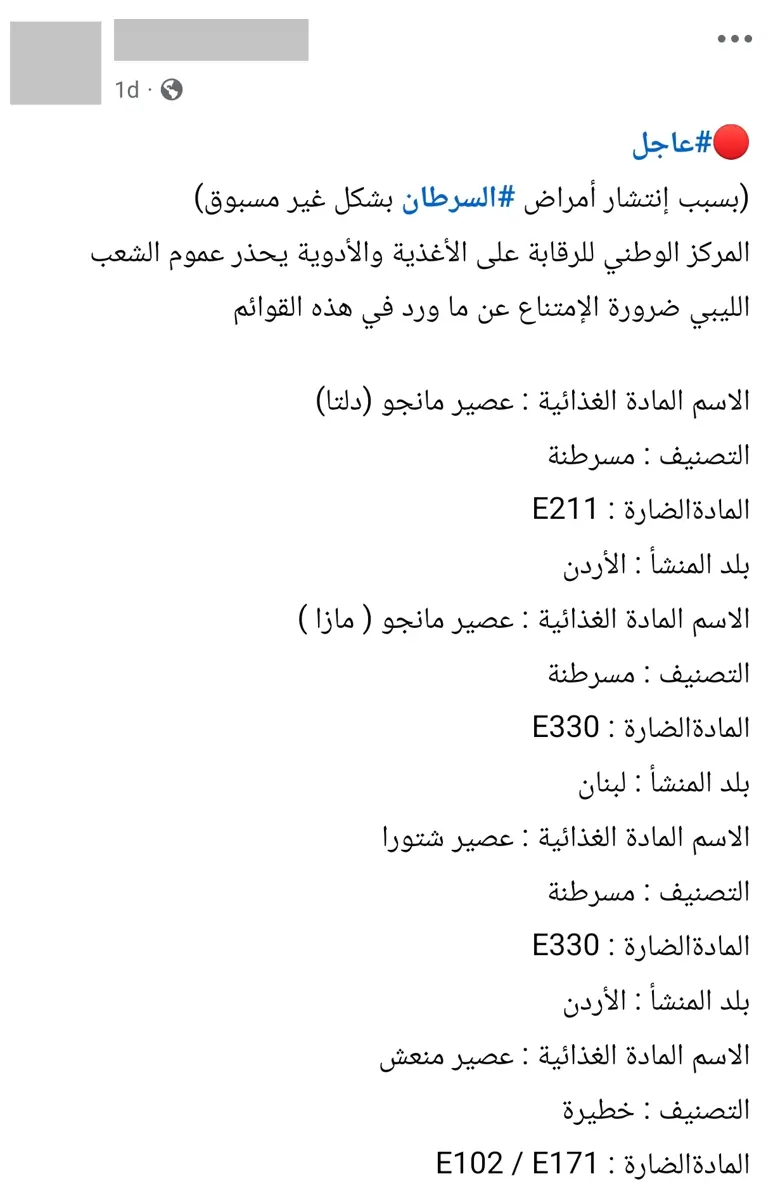
A Facebook post published on February 14, 2026, at 9:09 PM Libyan time, has been widely shared, claiming that the National Center for Food and Drug Control in Libya has warned against consuming specific food products allegedly containing cancer-causing substances. The post lists several products, including mango juice brands from Jordan and Lebanon, and has garnered significant attention, with nearly 440 interactions and 89 shares on Facebook.
An investigation by Annir has revealed that the claims made in the post are misleading. The center's former head of quality and chemical analysis, Eng. Ali Abdul Sid Ghania, a food expert, confirmed that the list did not originate from the center. He stated that such claims resurface annually in various forms without an official source and that food additives are regulated by Libyan standards, with permissible limits set by international food safety guidelines.
According to Ghania, the post confuses different substances, with some, like E211 (sodium benzoate) and E330 (citric acid), being internationally permitted within specified limits. However, other substances mentioned, such as E102 (Tartrazine), E122 (Carmoisine), and E171 (Titanium dioxide), are subject to restrictions or regulatory reviews in Libya. He emphasized that safety assessments of food additives are conducted scientifically by international committees comprising the World Health Organization (WHO) and the Food and Agriculture Organization (FAO).
A search on the official website and social media page of the National Center for Food and Drug Control in Libya did not yield any matching warnings or official statements regarding the listed products. It was also found that these lists have been shared and reshared over the years in different forms, without any official documentation or reference to a specific decision or statement from a governmental or professional institution.
Based on the findings, Annir's team has classified the claim as misleading, as the circulating list was not issued by the National Center for Food and Drug Control and contains inaccurate information and generalizations about food additives. The regulation of food safety is conducted through official, documented data, not through unknown sources on social media platforms.
The incident highlights the need for verifying information, especially when it comes to public health concerns. Annir's investigation underscores the importance of consulting official sources and regulatory bodies for accurate information on food safety and health advisories.
Key points
- The National Center for Food and Drug Control in Libya has not issued any official warnings regarding the food products listed in the viral social media post.