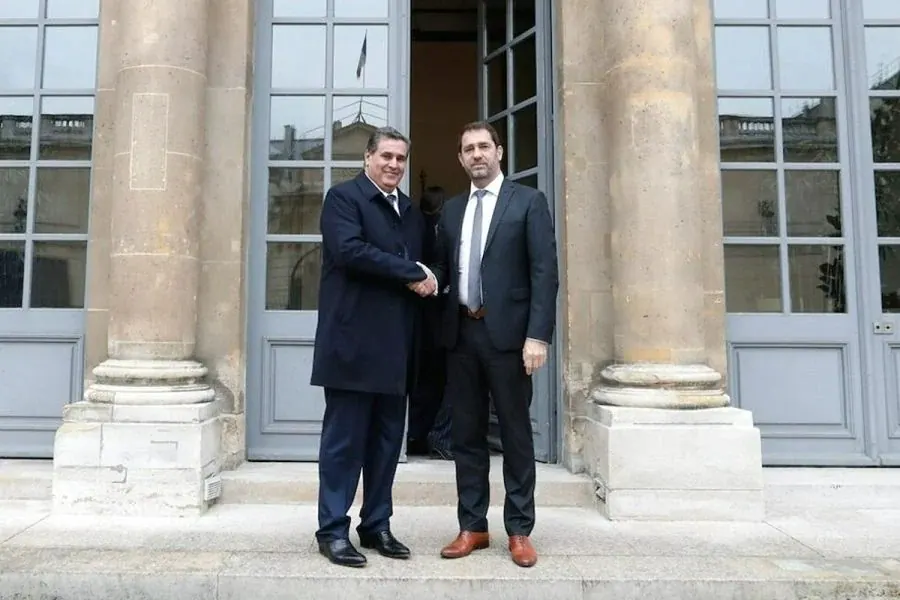
Christophe Castaner, former French Interior Minister and current President of the supervisory board of the Grand Port of Marseille-Fos, has expressed his views on the evolution of relations between Paris and Rabat. In an interview with Hespress, Castaner highlighted the solid foundation of the Franco-Moroccan relationship, which he attributes to their shared history and essential security cooperation. He noted that the relationship has become more operational, focusing on projects, investment, and economic, logistical, and energy issues.
According to Castaner, the arrival of Aziz Akhannouch's government in 2016 marked a significant shift in the relationship between the two countries. The dialogue between Paris and Rabat has become more intense and operational, with a focus on concrete projects and common investments. This change is particularly evident in the economic and port sectors. As the head of the Marseille-Fos supervisory board, Castaner has observed a new approach to work, prioritizing project implementation and industrial complementarity over the past five years.
Two key issues now structure this cooperation: strategic sovereignty and the energy transition. These topics have taken center stage in discussions between the two Mediterranean shores, opening up new investment opportunities. Castaner advocates for a vision of the Western Mediterranean that goes beyond its traditional role as a transit corridor between Asia and Europe. He envisions it as a production and value creation space, with complementary production units, integrated logistics corridors, and increased cross-investments in strategic sectors.
The former minister rejects the idea of direct competition between Tanger Med and Marseille-Fos, instead promoting a logic of complementarity. The French port could serve as a gateway to the European market, while Moroccan infrastructure provides privileged access to African and Atlantic markets. This cooperation is not limited to economic matters; Castaner also praises the outgoing Moroccan government's action, citing the "total commitment" of the Prime Minister and his ministers.
Castaner recalled his meeting with Aziz Akhannouch during the creation of En Marche in France and the refoundation of the RNI in Morocco. He believes that the RNI's renewal ambition, led by Akhannouch, has yielded results. This appreciation comes just days before the legislative election and reflects Castaner's broader analysis of the past five years as a period of growing economic and strategic rapprochement between Rabat and Paris.
According to Castaner, the Franco-Moroccan relationship is no longer solely based on historical legacy; it is now built around shared interests, common projects, and increased cooperation focused on investment and future economic transformations. The former minister's comments highlight the strengthened ties between the two nations, with a focus on pragmatic cooperation and mutual benefit.
The interview took place just days before the September 23 legislative elections, with Castaner sharing his insights on the evolving relationship between Morocco and France. His comments underscore the deepening partnership between the two countries, driven by shared strategic interests and a commitment to collaborative projects.
Key points
- Christophe Castaner praises the strengthened Morocco-France ties under Aziz Akhannouch's leadership
- The relationship between Paris and Rabat has become more operational, focusing on projects and investments
- Castaner advocates for a complementary approach between Tanger Med and Marseille-Fos, promoting cooperation in strategic sectors