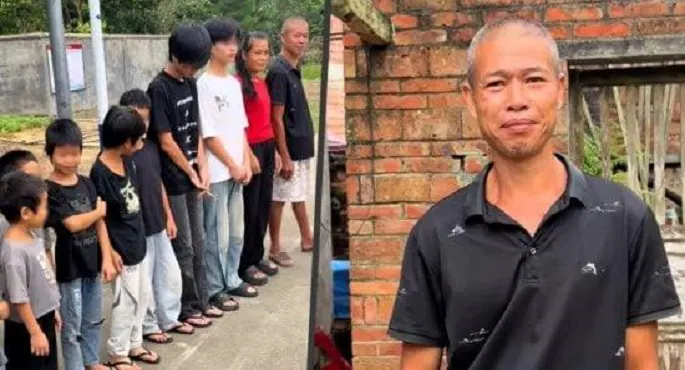
A Chinese couple, Mr. and Mrs. Huang, has 13 children, a rare case in China where the birth rate is declining. The couple, in their 40s, live in a village in Guangxi province and have eight sons and five daughters. Their children range in age from two to 22 years old, with the oldest being married and the youngest still in preschool. The family relies on farming for their income.
The Huangs' decision to have many children is driven by a desire to avoid loneliness and bullying. Mr. Huang said that having a large family helps reduce the risk of bullying in the village and gives him a sense of security in his old age. The family receives 3,500 yuan ($520) in monthly government subsidies, which helps them stay above the poverty line. They also received financial assistance to build a two-story house.
The couple's family structure is unusual, with their first two and last three children being girls, and the rest being boys. Their children are all enrolled in school, and Mr. Huang prioritizes their education. Despite the challenges of raising a large family, Mr. Huang expressed happiness and pride in his children, saying that hearing them call him "father" brings him joy.
However, the family faces financial struggles, including debt from a 2016 accident that left Mr. Huang with serious injuries and 100,000 yuan ($15,000) in medical expenses. He continues to work long hours on the farm, often in pain, to support his family. Mrs. Huang is reportedly in good health despite having given birth to 13 children.
China's family planning policies have changed over the years, from a one-child policy to a two-child policy in 2016, and then a three-child policy in 2021. Couples who violate these policies face penalties, but the exact amount of fines the Huangs may have paid is unclear. Local authorities have visited the family several times, trying to persuade them to stop having more children.
The Huangs' case has sparked debate about family planning policies and social stigma in China. While some people praise the couple for their large family, others criticize them for violating birth control policies. The family's situation highlights the complexities of family planning in China and the challenges faced by large families.
Despite the challenges, the Huangs continue to live their lives, relying on farming and government subsidies. Their case has drawn attention to the realities of family planning in China and the difficulties faced by families who choose to have many children. The government has implemented policies to encourage larger families, but the Huangs' situation shows that there is still much work to be done.
Key points
- The Huangs' decision to have 13 children is driven by a desire to avoid loneliness and bullying.
- The family receives 3,500 yuan ($520) in monthly government subsidies.
- China's family planning policies have changed over the years, from a one-child policy to a three-child policy.