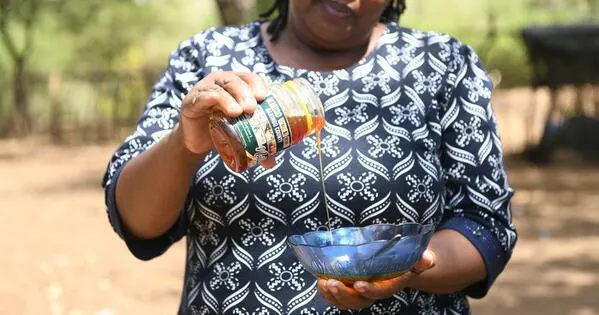
In Kenya's Baringo County, a local women's group has successfully adopted beekeeping techniques learned from China, transforming a traditionally male-dominated field. The Lelkolo women's group, consisting of 21 members, has learned to manage beehives and harvest honey, defying conventional norms. This change was made possible by agricultural extension officer Aholipama Chelagat Rutto, who acquired beekeeping knowledge from a training program in China.
Rutto's journey to China in 2017 marked a significant turning point in her beekeeping career. She attended a training program on bee production and oil-crop yield improvement, organized by China's Ministry of Commerce. The program, undertaken by a local agricultural science and technology institution, provided Rutto with systematic training in apiary construction, colony breeding, and hive management. She also learned techniques for pest and disease control, honey maturity assessment, and honey extraction.
Upon returning to Kenya, Rutto began sharing her newfound knowledge with local women, aiming to empower them economically. She introduced modern hives, including Langstroth hives, along with protective clothing and specialized tools. These innovations lowered the barriers to beekeeping and honey harvesting, enabling women to handle the entire process independently. The women's group has since made significant progress, harvesting 612 kg of honey in 2025 and earning approximately 500,000 Kenyan shillings.
The impact of beekeeping on the women's lives extends beyond income generation. For Grace Cheserem, chairperson of the Lelkolo women's group, beekeeping has brought about a sense of independence and shared household responsibilities. Her husband now assists with household chores, and the income from honey sales has enabled them to purchase livestock and supplement their household expenses. Beekeeping has also provided a reliable source of income, as crop farming becomes increasingly uncertain due to climate change.
Faith Kittony, secretary of the women's group, emphasized the significance of beekeeping in the face of climate uncertainty. Drought has severely affected some parts of the area, causing large reductions in crops such as maize and beans. However, the income from beekeeping has provided a vital lifeline, enabling the women to support their families. The group's success has also attracted attention from neighboring villages, with residents seeking to learn from their experience.
As the women's beekeeping operation expands, Rutto is now introducing the concept of value-added honey processing. She plans to train the women to produce other bee products, such as body lotion, lip balm, and beeswax products. This development will enable the women to diversify their income streams and increase their economic stability. Rutto has already passed on her knowledge to about 84 beekeeping groups in the county, with a ripple effect on the local community.
Rutto's experience in China has had a lasting impact on her approach to beekeeping and knowledge sharing. She believes that knowledge becomes truly valuable when shared with others. By empowering local women with beekeeping techniques, Rutto has created a sustainable and economically viable opportunity for them. The Lelkolo women's group's success story serves as a testament to the potential of international knowledge sharing and collaboration in driving positive change.
Key points
- A Kenyan women's group has learned beekeeping techniques from China, breaking traditional gender roles and opening new income opportunities.
- The women's group has harvested 612 kg of honey and earned approximately 500,000 Kenyan shillings in 2025.
- Beekeeping has provided a reliable source of income for the women, enabling them to support their families and invest in their future.