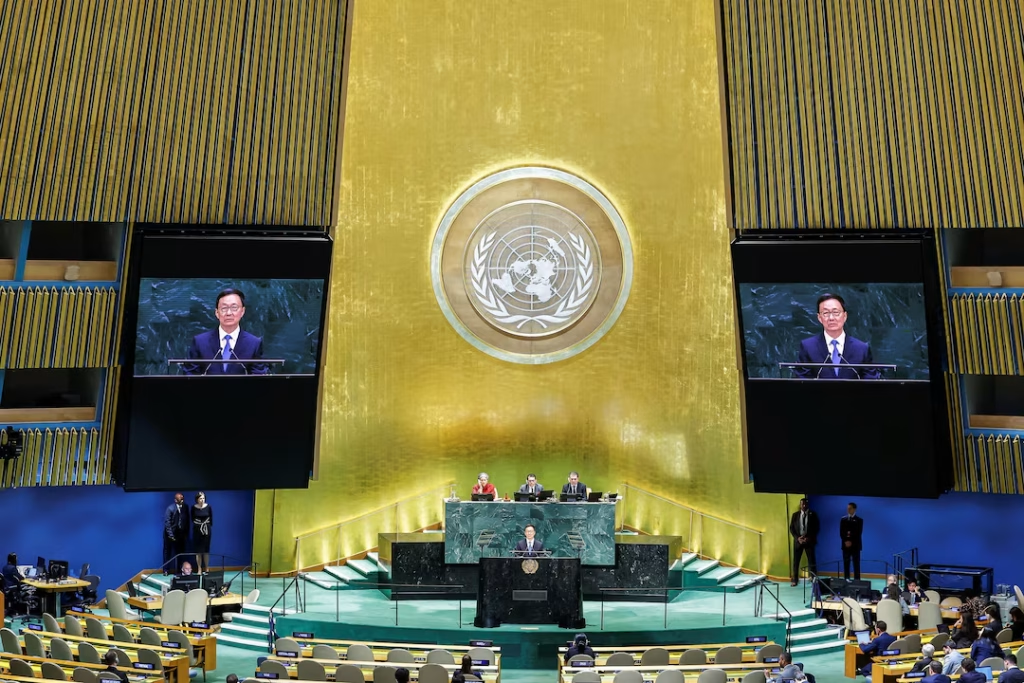
China's Vice President Han Zheng addressed the 81st United Nations General Assembly on September 26, 2026, emphasizing the importance of respecting the sovereignty and security of Middle East countries, including those in the Gulf region. He did not directly mention the US but called on powerful nations to adhere to international law and refrain from using force or threats against other countries. Han's statement came amid ongoing tensions between the US, Israel, and Iran.
Han Zheng reiterated that major countries have a special responsibility to protect international peace and security and should be at the forefront of respecting international law. This stance was made against the backdrop of the ongoing conflict between the US, Israel, and Iran, with Washington maintaining pressure on Tehran. The US Ambassador to China reported that President Donald Trump had warned President Xi Jinping about not providing assistance to Iran during their meeting at the White House.
China has been accused of aiding Tehran in circumventing sanctions, including in matters of oil sales and defense equipment. These allegations have contributed to the broader political tensions between Washington and Beijing. In response, Han Zheng called on the US to cease what he described as threats of using force against Cuba and to lift economic sanctions and embargoes against the island nation.
The call to lift sanctions against Cuba was echoed by Russian Foreign Minister Sergey Lavrov, who urged Washington to end what he termed the "siege" of Cuba and remove trade barriers. Cuba is currently facing significant energy and infrastructure challenges, including issues with oil supply and frequent power outages. Han Zheng's speech also highlighted China's role as a partner to developing countries.
He emphasized that all nations, large and small, should have equal standing in the international community and that global issues should be addressed through joint consultations rather than unilateral decisions. This stance is reflective of China's broader diplomatic efforts to promote a more multipolar world order. The Chinese government's position on these issues has been closely watched by international observers.
The developments at the UN General Assembly underscore the complex dynamics of international relations, particularly in the context of the Middle East and US-Cuba relations. China's statements have been seen as part of its ongoing efforts to assert its influence on global governance and advocate for a more equitable international system. The reactions from various countries and international organizations to these calls are yet to be fully determined.
The international community remains attentive to the potential shifts in policy and alliances that could arise from these diplomatic exchanges. As global powers continue to navigate complex geopolitical challenges, the outcomes of such discussions are likely to have significant implications for international peace, security, and economic cooperation. The situation continues to evolve, with stakeholders closely monitoring developments.
Key points
- China urges the US to respect the sovereignty of Middle East countries and lift sanctions on Cuba.
- The call for lifting sanctions against Cuba was also supported by Russian Foreign Minister Sergey Lavrov.
- China's stance reflects its broader diplomatic efforts to promote a multipolar world order and advocate for a more equitable international system.