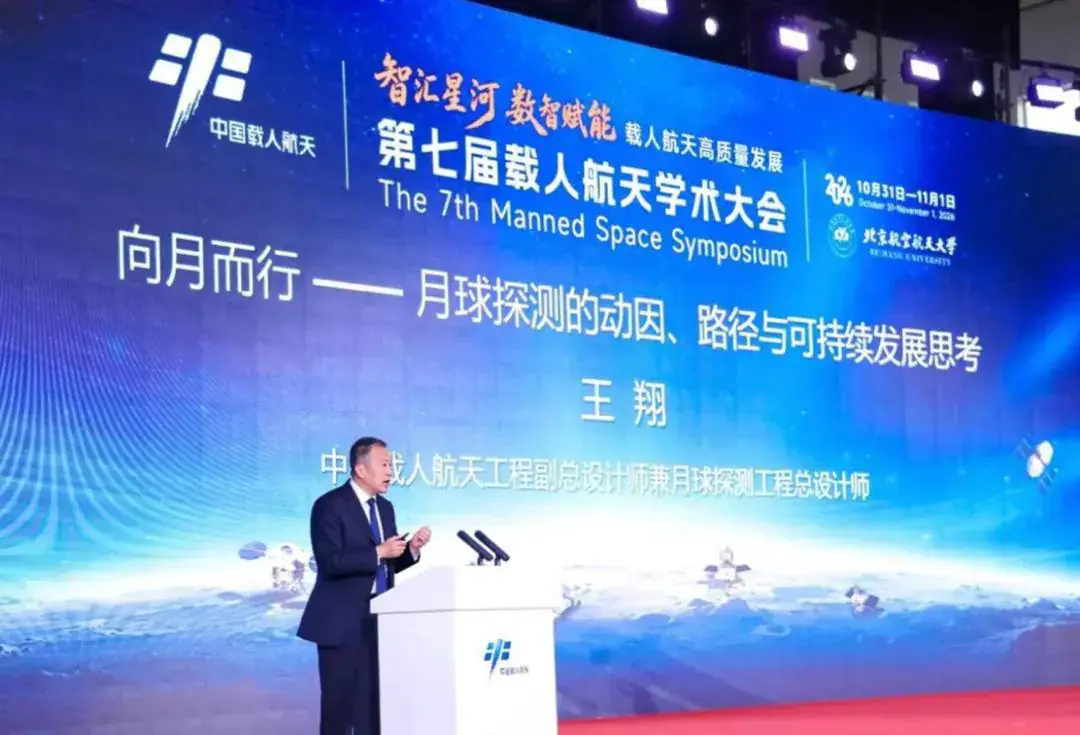
China's space program has revealed a detailed operational plan for a manned lunar landing by the end of 2030. Wang Xiang, deputy director of the Chinese manned spaceflight program and chief designer of the lunar exploration program, presented the plan at the 7th Academic Conference on China's Manned Spaceflight. The mission involves a two-launch approach, with the first launch sending the Lanyue lunar lander into space and the second launch carrying three astronauts and the Mengzhou spacecraft.
The Lanyue lander will deploy its solar panels and autonomously navigate to the Moon, entering into a circumlunar orbit. Meanwhile, the Mengzhou spacecraft will travel 380,000 kilometers to join the lander in orbit and dock with it. After docking, two of the three astronauts will enter the lander, which will then separate from the spacecraft and begin its descent to the lunar surface. The lander's braking module will detach during descent, leaving only the landing module to touch down safely in the targeted area.
Once on the lunar surface, the two astronauts will conduct essential scientific work, including walking on the Moon, making scientific observations, and collecting lunar soil samples. After completing their tasks, the Lanyue lander will autonomously take off, re-enter circumlunar orbit, and dock with the Mengzhou spacecraft. The astronauts will then transfer back to the spacecraft, bringing valuable lunar soil samples with them.
The Chinese approach has been praised by space enthusiasts worldwide for its efficiency, pragmatism, and ingenuity. Compared to traditional mission plans, China's two-launch approach offers several advantages, including enhanced safety, reduced risk, and improved cost-effectiveness. The plan leverages existing launch vehicles and spacecraft, minimizing the need for significant new developments and reducing costs.
China's lunar exploration program has made significant strides in recent years, including the successful Chang'e-6 mission in 2024. The mission retrieved samples from the far side of the Moon, a region that has been largely unexplored by humans. This achievement has provided valuable scientific data and technical experience for future manned missions.
China's space program is committed to peaceful cooperation and development, rejecting a competitive mindset in favor of collaborative progress. The country's manned lunar landing plan demonstrates a mature grasp of deep space exploration technologies and offers a new paradigm for human lunar exploration.
The mission's success will depend on the continued development and validation of key technologies, including orbital docking, lunar landing, and deep space return. With its innovative approach and emphasis on cooperation, China's lunar exploration program is poised to make significant contributions to the global space community.
Key points
- China's manned lunar landing plan involves a two-launch approach, aiming to enhance safety and efficiency.