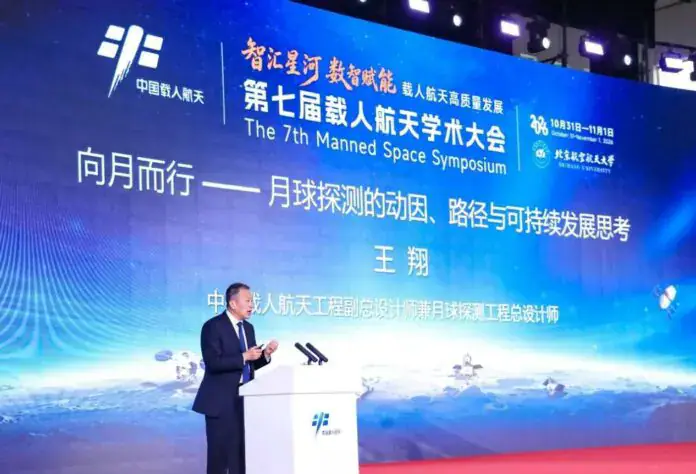
China's ambitious plan to send astronauts to the Moon by the end of 2030 has taken a significant step forward. Wang Xiang, deputy director of the Chinese manned spaceflight program and chief designer of the lunar exploration program, revealed a detailed operational plan for the manned lunar landing at the 7th Academic Conference on China's Manned Spaceflight on October 31. The plan involves a "two launches, one landing" approach, which aims to accomplish the manned mission to the Moon with better risk management and enhanced efficiency.
The mission will involve two launches of the Long March 10 rocket. The first launch will place the Lanyue lunar lander on a transfer trajectory to the Moon, where it will deploy its solar panels and autonomously navigate to a circumlunar orbit. The second launch will carry three astronauts and the Mengzhou spacecraft, which will travel 380,000 kilometers to the Moon and dock with the Lanyue lander in circumlunar orbit. This approach allows for a more manageable and safer mission, with each segment of the flight being simpler and more tolerant of errors.
Once the docking is complete, two of the three astronauts will enter the Lanyue lander, which will then separate from the Mengzhou spacecraft and begin its descent to the lunar surface. During the descent, the braking module will detach, and the lander will touch down softly in the targeted lunar area. The two astronauts will then conduct essential scientific work, including walking on the lunar surface, scientific observations, and sampling lunar soil. The Lanyue lander will then take off autonomously, rendezvous with the Mengzhou spacecraft, and transfer the astronauts and lunar samples.
The Chinese approach has been widely praised by space enthusiasts globally for its innovative and pragmatic solution. Compared to traditional plans, China's "two launches, one landing" approach offers several advantages, including enhanced safety, reduced risks, and improved cost-effectiveness. The plan leverages existing launch vehicles and spacecraft, eliminating the need for a new, heavy-lift launch vehicle and reducing development costs and timelines.
China's lunar exploration program has made significant strides in recent years, including the successful Chang'e-6 mission in 2024. The mission retrieved samples from the far side of the Moon, a region that has been largely unexplored by humans. The returned lunar soil from the South Pole-Aitken basin has helped bridge a scientific gap in the exploration of the far side of the Moon and provided valuable technical experience and scientific data for future manned missions.
China's commitment to peaceful and cooperative space exploration is reflected in its approach to lunar exploration. The country rejects a zero-sum mentality in space exploration and instead advocates for a collaborative and mutually beneficial approach. The manned lunar landing plan demonstrates China's mature and secure grasp of deep space exploration technologies and offers a new paradigm for human lunar exploration.
As China progresses with its lunar exploration program, the international community is watching with interest. The success of the manned lunar landing mission will not only mark a significant achievement for China but also contribute to the advancement of human knowledge and understanding of the Moon. With its innovative approach and commitment to cooperation, China is poised to play a key role in shaping the future of lunar exploration.
Key points
- China's plan for a manned lunar landing by 2030 involves a "two launches, one landing" approach to mitigate risks and enhance efficiency.
- The mission will leverage existing launch vehicles and spacecraft, reducing development costs and timelines.
- China's lunar exploration program has made significant strides in recent years, including the successful Chang'e-6 mission in 2024.