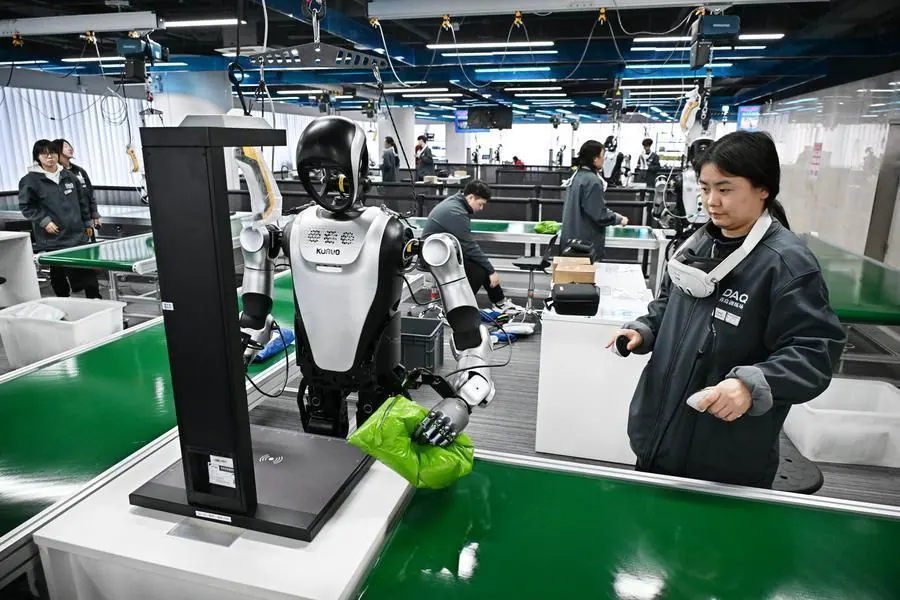
China's Ministry of Human Resources and Social Security has recognised new occupations, reflecting the country's shifting job landscape. Among these is the embodied intelligence robot technician, a role that requires skills in coding, AI perception systems, and robotics. Zhu Shaodong, a 25-year-old from Xiamen, works in this field, teaching robots to work in the real world. His job involves diagnosing problems and training robots with motion-capture data.
Zhu's work is part of a larger trend in China, where technology is driving changes in the job market. His company provides training in robot repair, maintenance, and development, and the industry is working on rating standards for this new occupation. The recognition of embodied intelligence robot technician as an official occupation is a significant development, highlighting the growing importance of AI and robotics in China's economy.
Another new occupation recognised by the Ministry is sports data analyst. Su Xing, a basketball fan and former civil engineering doctoral student, has developed an AI sports data analysis system called Qiuxiu. The system provides amateur basketball players with AI-edited highlight clips, complete with shooting stats and shot charts. Since launching in 2022, Qiuxiu has partnered with over 2,000 basketball courts and served more than 5 million users.
Su's innovation is connecting with the way people play sports today, making it possible for everyone who loves sports to be seen and recorded. The system is also expanding into North America, Europe, and Southeast Asia, with versions for badminton and tennis in development. This new occupation highlights the growing intersection of technology and sports in China.
In addition to these tech-driven occupations, China has also recognised traditional crafts as official occupations. Gu Junming, an incense artisan from Hebei Province, has spent over 40 years practicing the traditional incense-making craft. As a representative inheritor of the craft, Gu has refined classic formulas and co-authored industry standards for the craft.
Gu's work is not only preserving a cultural heritage but also introducing it to a new generation. He has teamed up with cultural brands, working with the Palace Museum and the Temple of Heaven on co-branded cultural and creative incense products. Gu has also offered free heritage classes in schools and communities, sharing his knowledge of incense materials and culture.
The recognition of incense artisan as a new occupation is expected to help push the traditional craft toward a more professional, standardised path of development. This development highlights China's efforts to preserve its cultural heritage while promoting innovation and technological advancement.
Key points
- China recognises new occupations, including embodied intelligence robot technician, sports data analyst, and incense artisan.