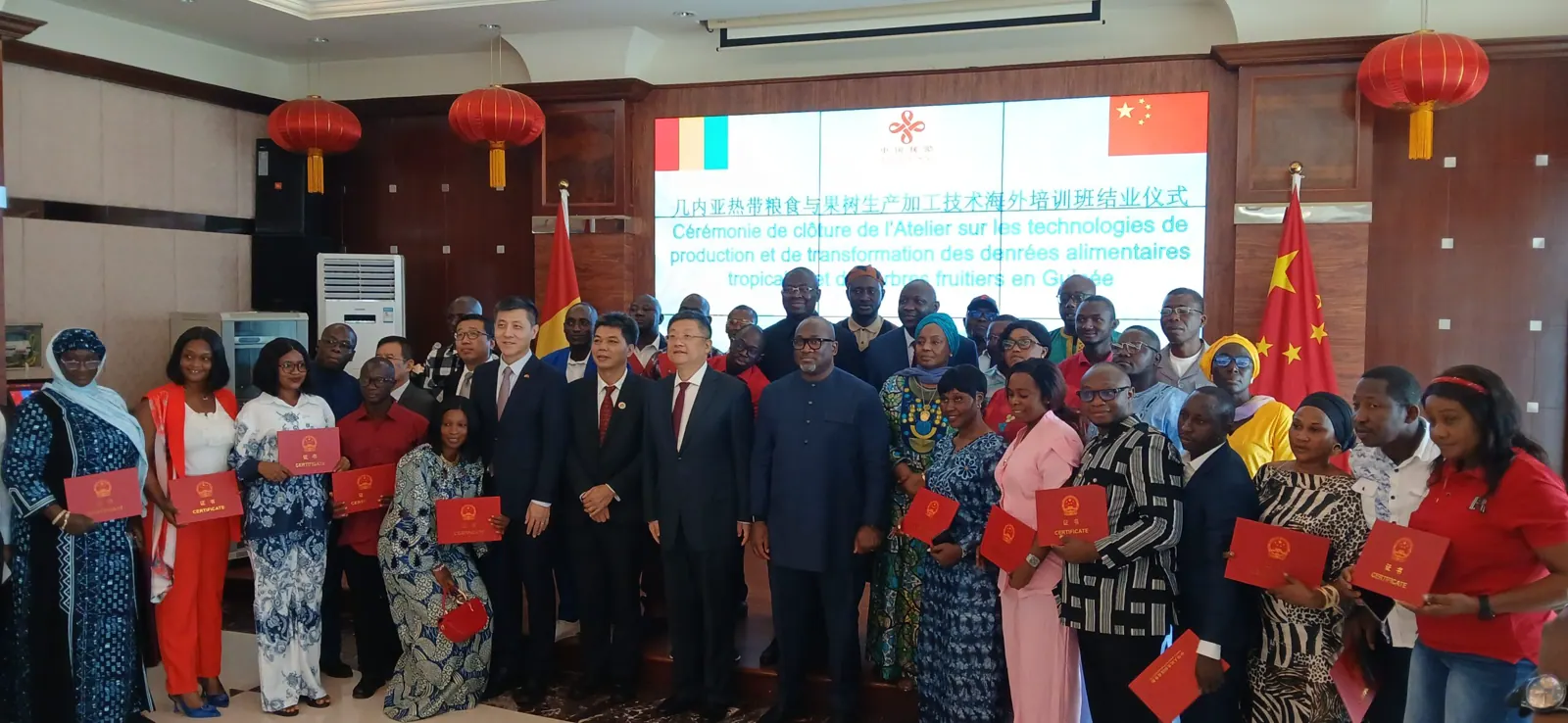
The Chinese Embassy in Guinea hosted a closing ceremony for a workshop on technologies for producing and processing tropical crops and fruits on September 30. The workshop, which lasted for 30 days, brought together around 30 officials from various ministries, including Agriculture and Livestock, Planning, and International Cooperation. The training covered techniques to improve productivity, reduce post-harvest losses, and enhance local processing of agricultural products.
The workshop covered various topics, including the cultivation and maintenance of tropical crops, varietal selection, disease and pest control, agricultural mechanization, and post-harvest conservation, storage, and transportation. The training also focused on the processing and valorization of by-products. According to Professor Ou Wenjun, a cereal expert from the Chinese Academy of Tropical Agricultural Sciences, the workshop emphasized practical training, with participants working on crops such as pineapple, banana, cassava, and sweet potato.
The training was conducted through a combination of theoretical courses, presentations, video projections, group work, and practical exercises. Part of the activities took place at the Kindia experimental station, where participants were directly involved in cultural operations on banana, pineapple, and almond plantations. Professor Ou Wenjun noted that this approach helped bridge the gap between theoretical knowledge and field realities.
However, the expert also highlighted several challenges facing Guinea's agricultural sector, including inadequate production infrastructure, limited means of controlling diseases and pests, post-harvest losses, and a shortage of agro-food processing equipment. The participants were trained on various aspects, including agricultural production and mechanization, varietal selection, post-harvest conservation, and processing and valorization of tropical products.
On behalf of the participants, Fanta Kaba praised the quality of the training and the experience gained from Chinese experts. Sékou Conté emphasized the need to transform this experience into concrete projects in Guinea, proposing the establishment of pilot plots and units to test and adapt certain technologies to local realities. Various Guinean institutions, including the Guinean Agricultural Research Institute (IRAG), could play a significant role in this phase of experimentation and technology transfer.
Chinese Ambassador to Guinea, Sun Yong, reaffirmed his country's commitment to supporting the modernization of Guinea's agriculture. He noted that Guinea has significant natural assets to develop its agriculture and achieve food self-sufficiency. Sun Yong also mentioned measures taken by China to facilitate access to its market for Guinean products, including a zero-tariff treatment for Guinean products destined for export to China.
Guinea's Minister of Agriculture, Félix Lamah, stated that the training aligns with the country's goal of strengthening its agriculture, agro-industry, and value chains. He requested that participants submit a report to his department and cabinet, accompanied by an action plan to implement the knowledge acquired. The minister also plans to strengthen cooperation with the Chinese Embassy to develop new training modules focused on five priority areas for transforming the agricultural sector.
Key points
- The Chinese Embassy in Guinea hosted a 30-day workshop on technologies for producing and processing tropical crops and fruits.
- The training covered techniques to improve productivity, reduce post-harvest losses, and enhance local processing of agricultural products.
- The participants were trained on various aspects, including agricultural production and mechanization, varietal selection, post-harvest conservation, and processing and valorization of tropical products.