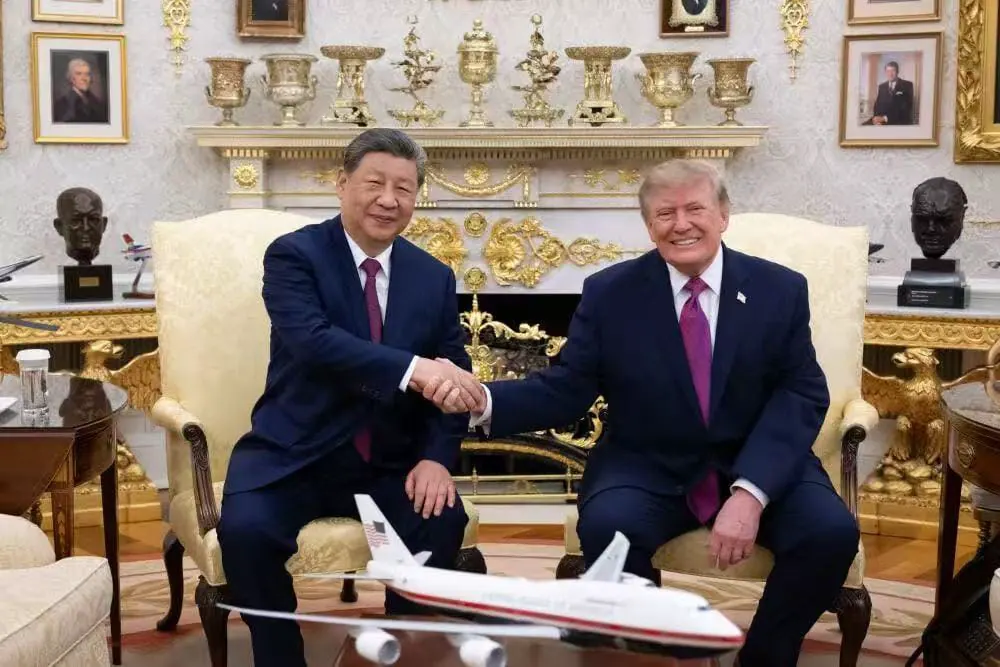
China and the United States have agreed on eight key points to strengthen their bilateral relationship. The agreement was reached after Chinese President Xi Jinping's state visit to the US. The two leaders, Xi and US President Donald Trump, pledged to cultivate a constructive relationship founded on strategic stability, respect, fairness, and reciprocity. They also agreed to support each other's major international events. China will host the 2026 Asia-Pacific Economic Cooperation Economic Leaders' Meeting, while the US will host the G20 Leaders' Summit.
The two leaders discussed trade and acknowledged the effectiveness of the China-US economic and trade consultation mechanism. They recognised the recent outcomes achieved by their respective economic teams, including a trade council and a $30 billion reciprocal tariff reduction arrangement. The leaders instructed their teams to implement the agreed outcomes. They also discussed Iran and nuclear non-proliferation, with Xi and Trump agreeing that Tehran must fulfil its commitment not to develop nuclear weapons.
The leaders also concurred that no country or institution should charge transit fees for passage through international waterways. They welcomed tangible results from joint law-enforcement efforts on counternarcotics cooperation. Chinese and US authorities collaborated on cases involving new psychoactive substances and precursor chemicals, leading to the arrest of dozens of suspects in both countries. This cooperation is seen as a significant step in their joint efforts to combat narcotics.
Artificial intelligence emerged as another significant area of agreement. Presidents Xi and Trump agreed to establish a China-US AI dialogue to exchange views on the risks and benefits associated with the rapidly developing technology. The next round of this dialogue is anticipated in November. The two sides will also create a communication channel for AI-related incidents. This comes as both nations continue to advance AI technologies amidst questions concerning safety, regulation, and economic competition.
The leaders also addressed people-to-people and cultural ties. The US side expressed enthusiasm for the upcoming arrival of two giant pandas, leased by China, to Zoo Atlanta. The release highlighted the shared history of China and the United States as allies during World War II. This visit aims to strengthen cultural ties and promote mutual understanding between the two nations.
Beyond the eight outcomes announced after the leaders' meeting, the Chinese and US militaries agreed to sign a memorandum of understanding. The MOU aims to strengthen crisis communication and prevent escalation. The two militaries will also continue their cooperation in searching for the remains of US soldiers in China. This cooperation is seen as a significant step in improving military relations between the two nations.
President Xi's state visit to the United States included an in-depth exchange with President Trump on bilateral relations and major international and regional issues. The visit followed the latest round of China-US economic and trade consultations in New York. The agreements announced after the visit underscore efforts by both governments to establish mechanisms for managing differences while maintaining cooperation in areas of shared interest.
Key points
- China and the US have agreed to establish a China-US AI dialogue to exchange views on the risks and benefits associated with AI.
- The two nations have agreed to support each other's major international events, including the 2026 Asia-Pacific Economic Cooperation Economic Leaders' Meeting and the G20 Leaders' Summit.
- The leaders instructed their teams to implement the agreed outcomes, including a trade council and a $30 billion reciprocal tariff reduction arrangement.